When am I going to die?

comments 4
Health / Medicine / Myths

Remember in Back to the Future when Marty McFly desperately tried to warn the 1955 Doc Emmett Brown that in 1985, Doc was to be gunned down by Libyan terrorists? Doc insists that he doesn’t want to know about the future. How about you? Would you want know in advance when you are going to die? Whether you do or don’t, the fact is no one can tell you that for sure anyway. But new research out of the UK can tell you the chances you’ll still be alive in five years based on your answers to some very simple questions.

What if you knew in advance when your time was up? Image credit uncoolbob via Flickr.

What if you knew in advance when your time was up? Image credit uncoolbob via Flickr.

A very big study

The first thing to tell you about this research is that it strictly applies only for people between the ages of 40 and 70 living in the UK. But it seems likely to me that this research will still shed some light on life expectancy for those of us aged between 40 and 70 living in Australia.

According to the researchers it is likely that the prediction works fairly well in countries that are similar to the UK in terms of distribution of demographic and socioeconomic factors, provision of healthcare and lifestyle and risk factor distribution.

The UK Biobank study collected very detailed health information (655 different measurements) from almost 500,000 people. Now that’s a decent sample size! The researchers followed these people for five years. At the end of that period, knowing who had died and who was still alive, they could calculate which health measures best predicted death within the five-year period.

The health data the researchers collected included blood tests, memory and reaction time tests, physical activity, diet, occupation, as well as personal and family histories of disease.

Of course what they found can’t tell you anything about your personal risk of dying, nor does the research say that a particular health measure causes death. It simply correlates certain health factors with the chances of dying in the next five years. And because they collected data from half a million people in their study, the researchers can be pretty confident about their findings.

What are the strongest predictors?

Somewhat unexpectedly, the factors that most accurately predict death within five years can be determined by answering a small number of simple questions by survey. There was no medical examination needed.

But the strongest predictor of whether you’ll still be alive in five years differs for women and men. Starting with women, the strongest predictor of death is a previous diagnosis of cancer. The second strongest predictor is whether a woman had experienced serious illness or injury in the previous two years.

Interestingly, for men it is a self-assessment of a man’s own health. Men are asked “in general how would you rate your overall health?’ The next strongest predictor was whether the man receives a disability allowance.

When the researchers only included people with no major diseases, smoking habits predicted death within five years for both women and men best.

How fast do you walk?

The researchers have created the Ubble online Association Explorer (Ubble is short for UK Longevity Explorer). The Explorer is an interactive graph allowing you to see the importance of each of the health factors the researchers looked at. The Explorer shows how good each health measure is at predicting death within five years. The graphs are separate for men and women because different factors were better predictors of mortality in the two sexes.

The graphs show each factor’s C-index, a measurement of how well that factor predicts death within five years. The higher the C-index, the more accurate the predictive ability.

Beyond the two strongest predictors for each sex, there are other fascinating findings. Both men and womens’ self-assessed walking pace (slow, steady or brisk) predicts death within five years. Other important factors for women are how many children she has given birth to, whether she smokes tobacco now (or did in the past), how she rates her overall health, whether she has any long-standing illness and whether she receives a disability allowance.

For men other significant questions are how many cars he owns or has the use of (presumably this is a proxy for socio-economic status), how many people live in his household and how those people are related, current and past smoking habits, diabetes, and previous diagnosis of cancer, heart attack, stroke or high blood pressure.

Calculating your risk

To calculate your own risk, simply go to the Risk Calculator and answer 13 questions if you’re male and 11 questions if you’re female. You will be told your percentage risk of dying in the next five years and also be given your “Ubble age’.

If your Ubble age is lower than your real age, your risk of early death is low. And how about if your Ubble age is higher than your real age? The researchers hope these results will help people to become more aware of their own health and make positive changes to their habits.

I’m happy to report my risk of dying within five years is 0.1% and my Ubble age is 24. As a 40-year old, I reckon I can live with those odds.

Links and stuff

Radio on demand

This post accompanies a radio segment on Triple R’s Breakfasters program on Wednesday 10 June 2015.

It’s not all in the mind

comments 6
Health / Myths / Psychology

Want to build more muscle, play sport more skillfully and heal better after injury, all without lifting a finger? Worried I’m trying to sell you something? Or that I’ve fallen for the latest self-help fad? You’re wrong. I’m talking about something as simple as mental imagery: imagining your body doing something before you actually do it. Think of it like a mental rehearsal without any body movement. Not an urban myth, there turns out to be some solid science behind the power of mental training.

Can you visualise your way to the perfect free throw? Image credit Tennessee Journalist via Flickr 1, 2

Can you visualise your way to the perfect free throw? Image credit Tennessee Journalist (modified) via Flickr

Can you shoot a free throw?

More than 50 years ago, Australian psychologist Alan Richardson carried out an experiment with student basketball players. He split them into three groups with the aim of exploring different ways of improving their ability to shoot free throws.

The first group practiced free throws every day for 20 days. The second group spent 20 minutes visualising themselves shooting free throws every day. If they missed a shot in their mind, they kept imagining the throw until they got it right. The third group didn’t practice or visualise.

Unsurprisingly students in the third group didn’t improve at all in the 20 days. But amazingly, the basketballers in the second group improved almost as much as those in the first group. Mentally practicing shooting free throws was almost as effective as actually shooting baskets in terms of improving their skills. And they didn’t even need to touch a basketball.

Sound like a fluke? After a bit more hunting I found that the same result had been found 20 years earlier with both dart throwing and basketball shooting. And very recently a study found that combining mental and physical practice improved coordination and movement accuracy when learning how to do a lay-up shot.

Imagining your way to sport success

Ok, perhaps you’re not a basketballer. But maybe I can pique your interest with some other studies. There has been a lot of research into the value of mental training to athletes over the last few decades.

The use of mental imagery has been shown to significantly improve successful passing rates among soccer players, and to lead to improved performance on the volleyball court.

Not into team sports? We’ve all heard that Tiger Woods likes to mentally rehearse his golf shots. Mental imagery has been shown to lead to improvements in accuracy and technique in tennis, and improved performance in high jump. Interestingly in this last study, results were even better if the high-jumpers moved their arms in the way they would while jumping as they imagined the jump.

Maybe you’re a gym junkie? In a fascinating twist, it turns out that you can build muscle by mentally contracting your muscles, without actually working them. Imaginary exercise can increase the strength of finger muscles by up to 35%. And mental imagery preserved arm strength during four weeks of arm immobilisation.

Imagery has also has also been shown to help athletes recover from injury and many elite athletes swear by the importance of mental imagery in their training.

I don’t think I could possibly do a jump, or especially a new trick, without having this imagery process. For me, this is so very key to the athlete I have become.

Emily Cook Olympic aerial skiing champion

Can your mind heal your body?

Unsurprisingly there has been a lot of interest into whether mental imagery can play a role in better health. Can imagining our bodies healing well lead to genuine improved healing?

There’s evidence that mental imagery provides additional benefits over physiotherapy and occupational therapy for people recovering from stroke.

Guided imagery led to improved outcomes for patients six months after knee surgery, and patients who did imagery exercises showed faster wound healing after gall bladder surgery.

Burn victims recover their normal movement faster if they imagine themselves performing those movements and people with Parkinson’s disease show much greater improvement in their ability to move if they combine mental imagery with physical exercises rather than doing the physical exercises alone.

Want to try it?

There are two ways you can imagine yourself performing an action and we know they both work.

You can imagine yourself as though you are actually doing the movement (what you would see if you were wearing a video camera on your head). Alternatively, you can imagine you are a spectator, watching a video of yourself.

Either way, we know the most effective visualisation uses all your senses – you need to feel, see, hear and smell what you’re doing.

So if you’re going to imagine yourself scoring some three-pointers, make sure you can feel the ball in your hands, hear the crowd going wild and see the ball sail through the hoop.

Links and stuff

Radio on demand

 This post accompanies a radio segment on Triple R’s Breakfasters program on Wednesday 3 June 2015. 

Do you taste what I taste?

comments 14
Biology / Health / Myths / Zoology

Confession time: I’m just a tad partial to chocolate. I blame my Dad who also qualifies as a chocoholic. But I’ll never forget a chocolate experience I had almost 20 years ago when I was given the opportunity to try some Gymnema sylvestre. Some what you say? It’s a herb, native to Indian and Sri Lankan forest that suppresses your ability to taste sweetness. And eating chocolate straight after the herb was extremely offputting. The chocolate had virtually no taste but had the texture of wax, or maybe soap. I could feel it coating my tongue and teeth and I couldn’t imagine ever wanting to eat chocolate again. That’s the power of our taste buds.

Cats taste differently to humans. for one thing, they can't detect sweetness. Image credit Susan E Adams via Flickr

A cat’s sense of taste is different to ours. For one thing, they can’t detect sweetness. Image credit Susan E Adams via Flickr

The famous five

You didn’t know it, but you were already developing preferences for particular flavours before you were even born. The food flavours you were introduced to in the amniotic fluid you were surrounded by before birth influenced you, as did the diversity of flavours in breast milk if you were breastfed.

These days you probably take for granted that you can taste a massive variety of flavours. But in fact, you have only taste buds that respond to five distinct tastes: sour, bitter, salty, umami (savoury) and sweet. Some researchers argue that fat should be considered a sixth primary taste.

At a basic level, your taste buds are there to make sure you eat nutritious things and avoid poisons. Each of your taste buds contains a group of 50 to 150 taste receptor cells that look a bit like a tightly-closed bunch of bananas. Taste receptor cells sample the food molecules in your mouth and report a sensation of taste to your brain. The complex flavours you taste are a result of both the taste and smell of food.

If you have a close look at your tongue in the mirror, you’ll notice lots of little pale bumps all over the surface. These are called fungiform papillae. Your taste buds are too small to see without a microscope but they can be found on these papillae. There are also taste buds on the roof of your mouth and on your throat. And you’ve got somewhere between eight and ten thousand taste buds which are replaced about every two weeks.

Are you a super-taster?

We used to think different parts of the tongue handled different tastes – for example that receptors for sweet were located on the tongue tip and the bitter region was at the back of the tongue. But we’ve known since 1974 that all taste buds can detect each of the five basic flavours.

What does differ though is the number of taste buds each person has. If you’ve got a particularly picky eater in your family, consider there may be something more than fussiness going on. Some people have many more taste buds than others and therefore have much stronger likes and dislikes of foods. These people are termed ‘super-tasters’.

If you’re one of the 15 to 21% of people who can’t bear to eat coriander and say it tastes like soap you can blame it on your genes. Researchers have identified several genes involved in taste and smell that seem to be responsible for peoples’ complete hate of the herb.

Of birds and cats

You are most likely accustomed to enjoying the full range of tastes but recent research has shown that not all animals get to enjoy the same diversity of flavours.

It seems penguins can only taste sour and salty and have completely lost the ability to detect sweet, bitter or umami flavours. Researchers worked this out when studying penguin DNA. They were looking for the genes that enable taste buds to pick up each of the five different tastes and found a number were missing. It’s possible this ability was lost as a result of penguins living in very cold environments. Research suggests receptors for these three tastes don’t work at very cold temperatures so over evolutionary time the genes have been lost. It was probably important that penguins maintained their ability to taste salt so they could keep track of their salt intake from the ocean and being able to taste sour would help a penguin avoid rotten food. But beyond that it seems a penguin’s palate is not tuned to fine dining.

In fact, research suggests all birds have lost their ability to taste sweetness. But in a fascinating twist scientists have found that hummingbirds, specialist nectar feeders, have repurposed their umami receptors so they can taste sweet.

And it isn’t just birds that have lost the capacity to taste sweetness. Unlike almost all other mammals studied to date, cats don’t have the ability to taste sweetness. Presumably being able to taste sweet is of little value if you never eat any fruit or vegetables. Tigers, lions, panthers, your tabby at home, none of them can taste sweetness.

Being able to taste the delicious sweetness of chocolate brings me so much joy I’m glad I’m not a cat. Because as I discovered all those years ago, chocolate without sweetness just isn’t chocolate. No thanks.

Links and stuff

Radio on demand

 This post accompanies a radio segment on Triple R’s Breakfasters program on Wednesday 27 May 2015. 

Living to a ripe old age

comments 5
Biology / Botany / Evolution / Health / Zoology

When I was a kid, I aspired to live to 100 so I could get my letter from the Queen. These days I have a rather different view of the monarchy and more insight into the pivotal role of good health in old age. Of course that hasn’t changed the fact I hope to live to a ripe old age. But once you start to consider other living things, you realise our human longevity record of 122 years and 164 days is piffling. If you want to talk old age, there are a plenty of other animals and plants with lifespans far more impressive than ours. The question is: why do some things live so much longer than others?

What's the secret to old age? And why do some creatures live much, much longer than others? Image credit: Sean Mason via Flickr (original artist unknown)

What’s the secret to old age? And why do some creatures live much, much longer than others? Image credit: Sean Mason via Flickr (original artist unknown)

The old age all-stars

Have you heard of Ming the mollusc? Possibly not, but in the context of old animals, Ming is a super star. Ming’s a deep-sea clam also known as an ocean quahog and was named after the Chinese Dynasty in power when it was born. Yes, scientists have calculated Ming was 507 years old. Was because Ming had to be killed to be part of the scientists’ study. You can age an ocean quahog by counting the rings on its shell but the animal dies in the process.

If 507 sounds old, how about deep-sea corals that have been recorded to be more than 4,000 years old? There are also marine sponges living in Antarctica that have been clocked at 1,550 years.

Back on land, Harriet the Galapagos tortoise was supposedly collected by Charles Darwin in 1835 and arrived in Australia in 1842. She lived for more than 100 years in the Brisbane Botanical garden and ended up at Australia Zoo where she was said to have been 176 when she died. Another tortoise, a pet of the Tongan Royal family, Tu’I Malila was known to be 188 at death.

When it comes to mammals, the endangered bowhead whale has been given the title of longest-lived. Bowhead whales live in the Arctic and are the second heaviest whales after blue whales.

Researchers have recently looked at the bowhead whale genome to see what they can learn about the secrets of long life. Clear evidence of their long lifespan came when a stone harpoon tip was recovered from inside the neck of a bowhead whale in 2007. The harpoon tip was dated to 1880, which means this whale was at least 130 years old. In fact, scientists believe these whales live to 200 years.

Plants do it even better

There are many claims the oldest known individual tree is a Giant Basin Bristlecone Pine, still alive and currently aged 5,065 years. But Rachel Sussman, author of The Oldest Living Things in the World says there is an Antarctic Beech tree in Lamington National Park here in Australian that is 6,000 years old.

Then there are clonal trees. The Pando quaking aspen grove is a colony of trees covering 43 hectares in Utah that is estimated to be 80,000 years old. To be clear: it is the single root system that has been alive for that long. Each of the 47,000-odd genetically identical stems are probably only 75 – 200 years old.

To put things into perspective: the Pando colony was around before humans had even arrived in North America. Right now, the colony weighs 5900 tonnes and is officially the heaviest living thing we know about on the planet. (Note that the largest living thing on Earth is a fungus).

And in case you haven’t been sufficiently impressed by the plants yet, how about a colony of seagrass living in the Mediterranean that includes patches which are 200,000 years old?

Immortality, anyone?

Remember Benjamin Button who lived his life backwards – starting old and ending young? Scientists have found a jellyfish that lives its life in a similar way. It effectively recycles itself, going backwards from an adult stage to an immature stage over and over again.

There is also a freshwater animal called a hydra that can self-renew and regenerate. By renewing their old cells, these tiny animals are thought to be able to live to 1,400 years.

These animals are just about as close to immoral as we’re ever going to find.

Old ain’t old

The question is: why can’t humans get much beyond 120 years whereas a whale can live to 200 years? Why is extreme old age so variable among different species?

We used to think it was fairly straightforward: an animal’s lifespan is roughly proportional to its body weight and heart rate. A big slow elephant will live for a much longer period than a small fast mouse. But birds and bats, although small, tend to live longer than many bigger animals and Ming shows small animals can live for a very long time.

Scientists still puzzle over why we see such a huge variety of ageing rates among living things. There are almost certainly genetic factors involved, and research has shown the way different species are able to repair bodily damage may be important.

Regardless of the reason it’s hard not to feel a little wistful about the way we humans are impacting Earth. We are changing the face of the planet in such a relatively tiny amount of time compared to the lives of some of the plants and animals we share it with.

Links and stuff

Radio on demand

 This post accompanies a radio segment on Triple R’s Breakfasters program on Wednesday 20 May 2015. 

Hitchhiker’s guide to life in space

comments 3
Astronomy / Health / Medicine / Myths

Did you ever go on the Gravitron ride at a show or fair? The ride spins faster and faster, and all of a sudden the floor falls away but you don’t fall with it. You remain pinned to the wall by forces three times that of normal gravity. It’s fun, unsettling, and for some, guaranteed to result in puking. Fortunately, whether you lose your lunch or not, the effects are short-lived. But what happens when your body experiences extremely high (and low) levels of gravity over longer periods, as is the case for astronauts? We know spaceflight is not kind to human bodies. With the help of a set of identical twins, NASA is busy trying to understand more about how our bodies respond to living in space.

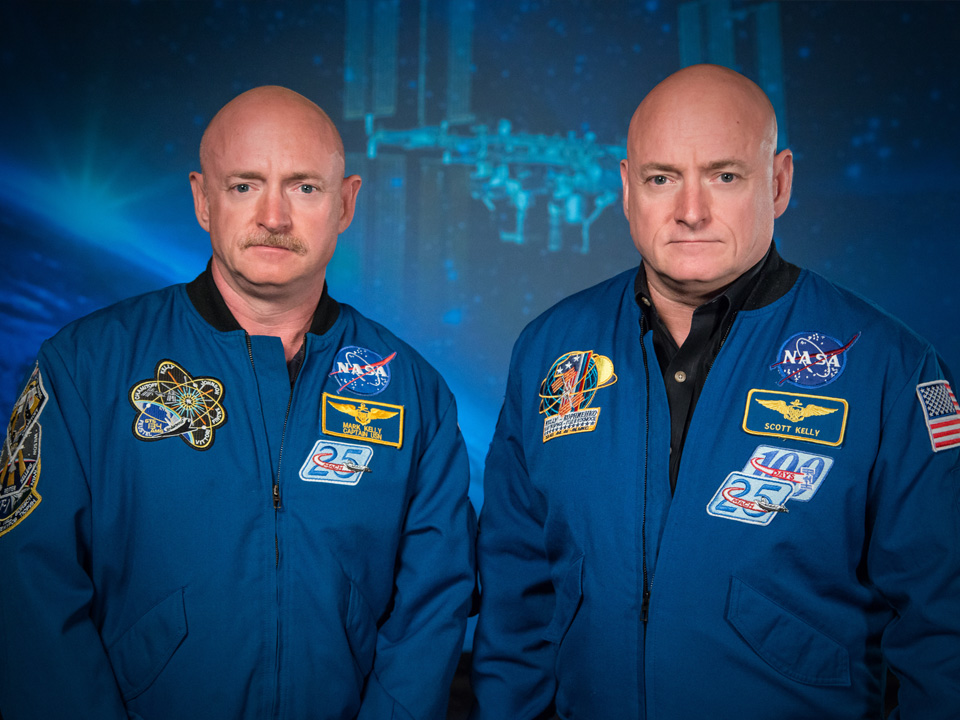
Astronauts Mark and Scott Kelly are part of a twin study

Identical twin astronauts Mark and Scott Kelly are helping NASA understand the effects of spaceflight on our bodies. Image credit NASA via Flickr.

There’s not a lot of gravity in space

Whether you’ve been on the Gravitron or not (and incidentally, you can buy your own Gravitron for US$55,000), chances are you know what I mean by gravity. Gravity is the force that causes every object to pull every other object towards it. Remember Isaac Newton and the apple that supposedly fell on his head? In space, people and objects appear to be weightless. Contrary to popular belief that there is no gravity in space, there is actually a small amount of gravity everywhere in space and the correct term is microgravity.

On the upside, astronauts grow up to three percent taller when in space. Without gravity compressing the disks between the bones of our backs, our spines lengthen. On the downside, we’ve known for a long time that human bones and muscles waste away in microgravity. Our bones need to be stressed to stay strong – that’s why we are told to do weight-bearing exercise to avoid osteoporosis.

NASA Astronauts spend about two and a half hours a day exercising to try to minimise these wasting effects. And of course these have to be special space exercises given that a dumbbell of any weight is still effectively weightless in space. But even with all that exercise and osteoporosis medication, an astronaut’s leg bone will still lose about 10% of its mass during a six-month stay in space. It seems exercise alone isn’t enough.

It’s not only bones and muscles that lose condition and age prematurely. Recent research showed that at the same time as the bones age, the immune system also ages. B cells are particularly important cells in our immune systems: they produce the antibodies we need to fight infections. B cells are produced in bone marrow in long bones like our leg bones and it seems as bones lose mass, their ability to produce B cells also declines.

Not just in your head

Other parts of our bodies have a tough time during space travel too. Astronauts who previously had 20/20 vision are returning to Earth and discovering they need glasses. Close monitoring of astronauts’ eyes in space has shown that in some astronauts, the rear of the eyeball becomes unnaturally flattened and in most, there is bulging in the optic nerve. These are both deformities that can cause permanent vision problems.

If that isn’t enough, exposure to high-energy cosmic rays can have all sorts of bad effects on your body such as an increased risk of cancer and reduced mental performance. Suffering from a hazy brain can’t be good when you’re in space and may be required to make snap life-and-death decisions.

And there are still other issues. Astronauts suffer sleep deprivation; it can’t be easy to sleep for ’normal’ periods when in space, sunrise and sunset alternate every 45 minutes. Most astronauts also report gaining much less pleasure from the food they eat. It’s not surprising space travel is also known to cause feelings of long-term isolation and depression.

Enter the twins

One of the issues scientists have in trying to fully understand the effects of space travel on humans is that all astronauts are genetically different. This simple fact makes it harder to generalise about the physical consequences of life in space. How could we overcome this problem? Ideally, you’d have many sets of identical twins, in each case, both trained astronauts who could undergo simultaneous missions – one in space and one on earth.

Unfortunately we don’t have lots of such twins, but we do have one set!

Mark and Scott Kelly provide the perfect opportunity to deepen our understanding of humans in space. Scott is currently spending one year living aboard the International Space Station, while Mark spends the same period on Earth. Scientists will take blood, saliva, urine and poo samples from the brothers before, during and after the year and also carry out psychological and physical tests. They plan to study a whole variety of aspects of human health, as it is influenced by space travel.

 Will we really colonise Mars?

Fortunately it seems unlikely I’ll be employed as an astronaut anytime soon (or be rich enough to afford a space joy flight). So none of this is a problem for me personally.

But people planning on living out their days on Mars might want to reconsider. Arriving on Mars and not being able to walk, see or think well doesn’t sound ideal.

Perhaps we’d do better to look after our own planet rather than assume we can successfully inhabit another.

Dr Kevin Fong puts it best:

Space isn’t an environment we’ve evolved to survive in.

Links and stuff


Radio on demand

 This post accompanies a radio segment on Triple R’s Breakfasters program on Wednesday 13 May 2015. 

Smells like nostalgia

comments 8
Evolution / Myths / Psychology

Is there a smell that has the power to transport you back in time? I bet there is. For me, just one whiff of an old-style canvas tent and I’m back camping with my family as a young kid. There are other evocative odours too. The yeasty aroma of bread dough rising in the sun and an Autumn bonfire piled high with damp plane tree leaves. Our noses are exquisitely sensitive and we are beginning to understand how smells are linked to emotion and memory.

Sometimes all it takes is whiff of a familiar small and we’re transported back in time. Image credit: Anaïs via Flickr

A Sunday roast? Grandma’s apple cake? Freshly-cut hay? Sometimes just a whiff of a familiar smell and we’re transported back in time. Image credit: Anaïs via Flickr

The science of smell

Smells are complex. For example, the scent of chocolate is made up of hundreds of different odour molecules. Our noses have 1,000 smell receptors, which occur in a small area in the upper part of the lining of our nostrils. These receptors detect odour molecules and send messages to the brain, resulting in us smelling a particular smell. There are also around 1000 genes involved in the process and the research that uncovered this process was awarded a Nobel Prize back in 2004.

Early estimates put the number of different smells our noses could distinguish at around 10,000. But research published last year upped that figure to one trillion different smells. That figure is an average – the range is 80 million to a thousand trillion unique scents for different people. These findings give our noses first prize for most sensitive organ in our bodies (in terms of the number of different inputs it can tell apart).

Why are our noses so sensitive? It’s possible we evolved to be great at detecting smells for safety. Scientists suggest our sense of smell may have been just as important as language in giving us modern humans an evolutionary leg up. The argument: it was a distinct advantage for our ancestors to be able to smell fire, tasty but hard-to-find food or food that had gone off.

Indeed, many women (myself included) will tell you they knew they were pregnant way before any pregnancy test could confirm it because of their enhanced sense of smell. It makes sense we have evolved to be particularly good at detecting food that could cause miscarriage. It’s also been proposed morning sickness nausea is a result of this heightened sense of smell.

And in fact without smell, we can’t even taste food. Next time you are congested, notice how little taste your food has. Or try this simple experiment: pinch your nose shut with your fingers and eat a jelly bean. It will taste a little sweet, but you won’t be able to work out what colour your jelly bean. Not until you open your nose, swallow, and allow the smell of the jelly bean to enter your nostrils.

Why smells evoke memories

Smells are surer than sounds or sights to make your heart-strings crack Rudyard Kipling

This Kipling line comes from the poem Lichtenberg in which an Australian soldier is transported home in his mind during the Boer war by the smell of wattle blossoms. I can relate. Pretty much the only time I felt homesick during a year living as an exchange student in Europe as a 16-year old was when I came across gum trees in Italy. The power of that smell to make me miss home took me by complete surprise. I completely agree that our noses are emotional time machines.

Scientists call this experience of particular smells making us immediately recall childhood memories olfactory-evoked recall. The effect is also known as the Proust phenomenon after a description in Proust’s In Search of Lost Time. In the scene in question, the author suddenly vividly recalls long-forgotten childhood memories while smelling a tea-soaked madeleine biscuit.

The most common nostalgic smells are associated with baking bread and cakes but other cooking smells are also common. And smells are not only good at evoking memories in general, they are particularly linked to emotional memories.

There are a number of theories as to why smell, memory and emotion are so tightly linked. A huge clue comes from the fact the olfactory bulb (the part of the brain responsible for processing information about smells) and the amygdala and hippocampus (regions of the brain associated with emotion and memory) are all located in close proximity.

Smells are connected to memories by networks of nerves in our brains and it has been shown when we smell something during an emotional experience, that smell is neurally woven together with the memory in the same region of the brain. Once the link has initially formed, a distinct smell has an amazing capacity to trigger the associated memory for many years to come.

What else do smells tell us?

Smells are powerful in other ways too. Your sweat can signal whether you are happy, and it’s no myth you can smell a person’s fear.

Research shows we are also good at sniffing out compatible romantic partners. Many animals, including humans, can identify potential partners that are genetically distinct from ourselves. Among other positives, this generally results in children with efficient immune systems. Men are also able to determine when a woman is most fertile based on her smell.

Businesses use scents to lure us into shops and to encourage us to be in the mood for shopping. If you google scent branding you’ll see what I mean. Something else to be aware of next time you go shopping.

For now, I say close your eyes and take a long, deep breath. How many different scents can you smell? How many of them can you put a name to? Marvel for a moment at the amazing capacity of your humble nose.

Links and stuff

Radio on demand

 This post accompanies a radio segment on Triple R’s Breakfasters program on Wednesday 6 May 2015. 

Who wants to be a billionaire?

comments 3
Ecology / Zoology

Late last week, my husband Euan Ritchie and I briefly ‘became’ billionaires in our quest to conserve some of Australia’s threatened mammals. Well ok, we never really had the cash, but that didn’t stop media outlets reporting we had ‘lost $2 billion’ when the pledged money later fell through. More on that saga later, but let’s dream for a moment. What could Australians do if we actually had that kind of money to spend on wildlife conservation?

Australia has many extraordinary species that aren’t doing well. With funding like that we’d be able to fund both the necessary research and practical conservation measures to save charismatic cute and furry species like the Northern Quoll, Victoria’s Leadbeater’s Possum, and Northern Hairy-nosed Wombat. We’d be able to secure the future of the Orange-bellied Parrot and Carnaby’s Black-cockatoo. And we could protect the Southern Corroboree Frog and Short-nosed Sea Snake. Finally, we could be confident the Lord Howe Island Stick Insect has a future.

Conservation

What would decent conservation funding mean to these Australian animals? Clockwise from top-left: Antilopine Wallaroo (David Webb), Spectacled Hare Wallaby (Henry Cook), Northern Quoll (Kieran Palmer via Flickr), Orange-bellied Parrot (Ron Knight via Flickr).

Would $2 billion cover my wish list? You bet. In fact Professor Hugh Possingham has estimated with just $400 million a year, we could save all of Australia’s threatened species. Sounds like a lot, but how about this for comparison. The annual federal defence budget is about $26 billion. So all we need to do is stop defence spending for three days and we could save all of Australia’s threatened species. Even if Australia stopped flying just one F/A 18 Super Hornet for half a year, we’d have enough funds to prevent the extinction of all of Australia’s birds for the next 80 years.

Australia’s sad extinction record

If you think I’m being overly cautious in worrying these species could be in real danger, unfortunately our history says otherwise. Over the last 200 years, Australia has lost more than 10% of our endemic land mammals, and a further 21% are considered threatened. Over the same 200-year period, North America has lost just one land mammal.

And unfortunately extinction isn’t a thing of the past. The Christmas Island Pipistrelle (a tiny bat) was confirmed extinct in 2009  — the first mammal to have gone extinct in Australia in 50 years. What happened? It was still common in 1984. The evidence is the bat disappeared because despite many warnings, the Australian government dilly-dallied and took no decisive action to prevent its extinction.

Conservation triage

As you might have guessed, there doesn’t appear to be anyone ready and willing to donate billions, or even millions to species conservation (Of course I’m happy to be proven wrong!). And government funding is being cut despite the fact we are losing species faster than ever before. What this means is we need to come up with strategies to ensure the limited funding we do have is spent in the best possible way.

If you’ve been to the emergency department of a hospital lately, the nurses you talk to first are highly trained in triage. They can assess whether you need immediate help or whether in fact someone else needs to take priority and you will be fine to wait a while. The conservation triage principle is similar. We need to prioritise our spending in order to use scarce financial resources most efficiently. The idea is to try to maximise our conservation successes given the limited money available.

Whether you agree with the principle of triage or not, one fact remains. We can’t make any informed conservation decisions without knowing what’s happening on the ground with our threatened animals.

Show me the data

Which brings me back to the $2 billion. Euan and I are currently running a Pozible crowdfunding campaign, the #BigRooCount, in order to continue our work with Australia’s northern kangaroos and wallabies. Ten years ago Euan and I had just finished four years of field work in remote parts of northern Australia, collecting information about four species of kangaroos and wallabies for Euan’s PhD. Our particular focus was the Antilopine Wallaroo. We know a lot about these populations from ten years ago but there haven’t been any ongoing studies since then.

Reports from indigenous communities aren’t good — they are seeing fewer and fewer kangaroos and wallabies. And Australia doesn’t have a good record when it comes to these animals. Roughly a third of the mammals we have lost over the last 200 years are kangaroo relatives.

The point is, without returning to the north, we won’t know what we’re up against or, more importantly, what could be done about it. That’s why we’re working hard to garner public support so we can raise the funds to find out what has happened to these kangaroos and wallabies over the past ten years. Professor Tim Flannery says it’s “fundamentally important research” and we are optimistic we’ll be able to raise the $15,000 we need to at least get started and resurvey all our north Queensland sites.

Euan Ritchie’s re-survey of kangaroos and wallabies across northern Australia 10 years on from his foundational PhD survey is fundamentally important research. Nobody but Euan can undertake the work, and I’m profoundly grateful that he’s willing to do it. Professor Tim Flannery

The Beatles famously said that money can’t buy love and the $2 billion pledge to our campaign that came and went is still a mystery. But a generous supporter could buy a lot of wildlife conservation love.

Links and stuff

Radio on demand

 This post accompanies a radio segment on Triple R’s Breakfasters program on Wednesday 29 April 2015. 

A glitch in the Matrix?

comments 2
Health / Myths / Psychology

“A black cat went past us and then another that looked just like it”. Remember when Keanu Reeves experienced déjà vu and was told it indicated a glitch in the matrix? Not restricted to Hollywood sci-fi, in fact almost all of us have had the disconcerting feeling that what is happening now has happened before (even when it hasn’t). After 150 years of scientific research, there are plenty of theories, but little consensus as to why we have these experiences.

Do you feel like we've been here before? Deja vu still has scientists baffled.

Do you feel like we’ve been here before? Déjà vu still has scientists baffled.

The French term déjà vu translates as ‘already seen’ and was first used in 1876. Psychiatrist Vernon Neppe defined déjà vu in 1983 as “any subjectively inappropriate impression of familiarity of the present experience with an undefined past.” More than just sense of familiarity, it’s the unnerving sensation that you’ve had an exact experience before. It’s weird precisely because to the best of your knowledge, that isn’t the case. But déjà vu is normal, and a common phenomenon. Given the amazing techniques we have these days to understand how our brains work, why don’t we have a good understanding of what causes déjà vu? It’s at least partly because I’m guessing last time you experienced it, you weren’t sitting in a lab with electrodes stuck to your skull. We don’t have any reliable way to trigger déjà vu and have to rely on peoples’ recollections of their own experiences, which will always be subjective. So despite déjà vu being a common topic in popular culture, our understanding of the scientific basis for it is still pretty murky.

What do we know?

Déjà vu is extremely common: studies have found between 60% and 80% of the population has experienced it. There are no gender differences, but more educated people experience déjà vu more often than those with less formal education. Déjà vu occurs more often when you are tired or stressed. Déjà vu appears to first occur in children aged eight or nine, is most common in people aged 15 – 25 years, but then tapers off as we age. As a result of this age-related pattern, researchers have suggested a link to brain development. Scientists have long known some experiences of déjà vu can be linked to temporal lobe epilepsy. Epileptics who have seizures centered on their temporal lobes often experience something similar to déjà vu just before the seizure begins. Because we know epileptic seizures are the result of alterations in electrical activity in the nerve cells, it has been argued déjà vu in non-epileptics is also the result of wayward electrical signals. But others believe the type of déjà vu experienced by epileptic patients is very different to ‘normal’ déjà vu. We also know some people experience constant déjà vu, and these people turn out to have brain damage to the temporal lobes. In one case, a 23-year old man felt as thought he was ‘trapped in a time loop’, an experience he described as very frightening.

Faulty memories, or something else?

Alan Brown, author of “The Déjà Vu Experience,” says there are at least 40 plausible scientific explanations for déjà vu. Many of the theories centre around the notion that our memories are prone to errors. The temporal lobes – the part of your brain behind your ears – are responsible for recognising something as familiar. The hippocampus is involved in recalling something has happened before. One explanation of déjà vu is that these two processes get out of sync. The way we form memories could also play a role. Experiences normally get stored in short-term memory before later making it into long-term storage. But if an experience accidentally bypasses the short-term, and instead goes straight to long-term memory, we can feel like the present has happened to us before. It could also be our brains get distracted by something after we’ve already unconsciously started taking in a scene around us. You know when you suddenly realise you’ve been “on another planet”? And when you snap back to reality, it feels like you’ve already been there. (D’Oh! That’s because you have been, a few seconds earlier.) Of course it may also be simply that something in our present situation reminds us of something we really have experienced before. The two situations aren’t exactly the same, but there are enough similarities that the new experience feels familiar. Maybe a new airport transit lounge has exactly the same layout as one you have spent lots of time waiting in. There is some evidence déjà vu occurs more frequently in people suffering anxiety disorders. Another possible explanation is that a person actually has experienced the situation or place before but has simply forgotten it! Or perhaps we are recalling our dreams. There are other explanations too. Carl Jung attributed déjà vu to the ‘collective unconscious’, others take déjà vu as evidence that we have some recall of our past lives, or alien abductions. Whatever the cause, I’m bummed that at my age I’m likely to experience déjà vu only about once a decade. That’s a long time to wait if I want to carry out some scientific research on my own déjà vu.

Links and stuff

Radio on demand

 This post accompanies a radio segment on Triple R’s Breakfasters program on Wednesday 15 April 2015. 

Seeing the light

comments 5
Health / Medicine / Myths

Did your parents tell you to turn off the TV and go outside to play when you were a kid? Perhaps they threatened that you were going to end up needing glasses if you didn’t stop playing computer games. At the time, you probably could have argued with them that being shortsighted was genetic and staring at a screen for too long had nothing to do with wearing glasses. But it turns out your folks may have been right after all, although not quite for the reason they thought.

Myopia

The causes of myopia are becoming increasingly clear. Image credit: Thomas Hawk via Flickr

Short-sightedness: more than just wearing glasses

Myopia, or shortsightedness is when you can see things close to you clearly but objects in the distance appear blurry. It results from the eyeball being slightly elongated, meaning that instead of focusing right on the retina, light from far objects focuses just in front of the retina. Shortsightedness is often diagnosed in school-aged children because the eye grows throughout childhood.

Usually, myopia can be easily treated. Whether you wear glasses, contact lenses or brave laser surgery, in most cases being shortsighted isn’t a big deal. But high myopia, a severe form of the shortsightedness, can be much more serious. If you have high myopia, you are at greater risk of developing serious eye conditions like glaucomacataracts and detachment of the retina, all of which can lead to blindness.

Until about 50 years ago, we thought shortsightedness was purely genetic. Studies published in the 1960s showed myopia to be much more common among identical twins, compared with non-identical twins. And it’s true you are more likely to be shortsighted if one of your parents also has the condition.

But over the past few decades the number of shortsighted people around the world has increased so dramatically we know there has to be something else going on. Genetic patterns simply don’t change that fast.

The myopia epidemic

Sixty years ago, only 10 to 20 percent of the Chinese population was shortsighted. But today up to 90 percent of all Chinese teenagers and young adults are myopic. The story is the same in other parts of Southeast Asia. In Seoul, an extraordinary 96.5% of 19-year old men are shortsighted. The same is true of  93% of 18-year old women in Taiwan. Scientists have found one-fifth of university-aged Southeast Asian people have high myopia that could result in blindness.

And it’s not just an Asian problem. Rates of shortsightedness in young adults in the United States and Europe have doubled in the last fifty years, and there’s no reason to think the situation is any different in Australia. Estimates are that by the end of this decade, 2.5 billion people — one-third of the world’s population — could be shortsighted.

If not genetics, then what?

German astronomer Johannes Kepler suggested around 400 years ago that spending too much time poring over books could cause blurry vision. And there is a strong correlation between the amount of time kids spend reading or being glued to phone, tablet and computer screens and the rise in myopia. It’s easy to imagine that spending too much time focusing on things right in front of your eyes wrecks your ability to see things in the distance.

It’s also easy to make a connection between the extremely high rates of myopia in Asia and the educational pressures and strong culture of long study hours (and also gaming) in Asian countries.

But actually, there is no evidence to support this myth. The leading theory as to why rates of shortsightedness are skyrocketing is even simpler.

Shining a light on shortsightedness

Professor Ian Morgan at the Australian National University (ANU) and others have proposed that the cause of myopia is, in fact, a lack of exposure to light. So it’s not just the fact kids are staring at screens that is the problem, but the fact they are spending their time indoors while doing it. Children who spend more time outdoors are less likely to be, or to become, myopic. And that’s true regardless of how much time they spend reading or whether their parents are shortsighted.

Animal experiments have supported the idea that being exposed to light is protective for our eyes. How could that work? Most likely because exposure to the sun stimulates production of the hormone dopamine, which blocks the elongation of the eye during growth.

It’s pretty clear that it is bright light stimulating dopamine release which prevents myopia.Ian Morgan, ANU

To seek evidence for this theory, Morgan’s team worked with twelve primary schools in Guangzhou in China. Half of the schools continued with their normal schedule of outdoor play while kids at the other schools spent an extra 66 minutes per day playing outside. After three years, kids at the school spending more time outdoors had on average 23% lower rates of myopia.

Ian Morgan recommends children spend three hours per day under light levels of at least 10,000 lux, which is the amount of light you would get sitting beneath a shady tree on a bright summer day (and wearing sunglasses). For comparison, light levels in a well-lit schoolroom or office are usually under 500 lux.

Of course there are many other arguments as to why kids should spend more time outside. Journalist Richard Louv argues our kids are suffering on many levels because they no longer spend time outdoors and have lost their connection to nature. He created the term nature deficit disorder to describe the negative consequences of a childhood spent mostly indoors.

Maintaining good eyesight is just one more reason to turn off all the devices and send the kids outside.

Links and stuff

Radio on demand

 This post accompanies a radio segment on Triple R’s Breakfasters program on Wednesday 1 April 2015. 

Big birthdays, big decisions

comments 4
Anthropology / Health / Myths / Psychology

Have you got a big birthday coming up, one that ends in a zero? And have you made any major life decisions recently? Although we measure time using a continuous scale, research has shown that in the year before a milestone birthday, people are more likely to reflect on their lives and make significant changes. Given destructive behaviours can result, it’s worth trying to understand why we are so affected by what are essentially arbitrary points in time.

Research shows we're more likely to make major, life-changing decisions just before milestone birthdays. But why? Image credit: Dave Haygarth via Flickr.

Research shows we’re more likely to make major, life-changing decisions just before milestone birthdays. But why? Image credit: Dave Haygarth via Flickr

Happy birthday to you

Whether you are 29 or 32, or 38 or 41 right now, your age probably doesn’t have a strong influence on your life. In fact, unless you are about to hit 18 or another milestone that will make it legal for you to vote, drive or drink alcohol, I’m guessing your exact age is fairly meaningless.

But research shows humans are very tuned into real or perceived fresh starts when it comes to changing our habits and tackling our personal goals. For example, we know people are more likely to think about their health on Mondays. And people Google the term ‘diet’ and go to the gym much more often at the start of each new calendar cycle: the beginning of a week, month or year, as compared to at other times. Ever made a New Year’s Resolution?

And it turns out, birthdays act as strong landmarks for us, interrupting the ‘seemingly unending stream of trivial and ordinary occurrences that happen to us every day’. No surprises then that a birthday has the power to inspire changes in our behaviour.

Research published late last year explored whether approaching a new decade in age has any effect on our behaviour. The researchers looked at a few specific behaviours of people aged 25 to 64. They were particularly interested in people they nicknamed the ‘9-enders’ – people aged 29, 39, 49 and 59.

What’s the meaning of life?

First the researchers considered results from the World Values Study. As part of this study, more than 42,000 people from 100-odd countries were asked how often they think about the meaning of life. Most people reported thinking about the meaning and purpose of their lives often, but 9-enders were found to consider these things significantly more often than people whose age ended in any other digit.

We might expect that contemplating whether your life has meaning could result in either a positive or negative response depending on your conclusion. And that’s exactly what the researchers found.

Of marathons and affairs

On the positive side, being a 9-ender makes it more likely you will run your first marathon, a definite positive challenge. The researchers looked at the ages of 500 first-time marathon runners and 74 of them were 9-enders. That number is 48% more than we would expect if age had no relation to when people decide to run their first marathon.

The researchers also looked at whether race times suggest 9-enders train harder than at other stages of their lives. And yes, runners aged 29 or 39 tended to finish about 2% faster at this age compared to the years before and after that birthday. This suggests they trained harder for the race in the year before they turned 30 or 40.

But the study also assessed the ages of more than 8 million male users on an online dating site specifically designed for people seeking affairs. There were more than 950,000 men aged 29, 39, 49, or 59 which was nearly 18% more than would be expected by chance. (Note the pattern was also true for women, but the trend wasn’t as strong).

Major birthday, major decisions

People are more apt to evaluate their lives as a chronological decade ends and, as a result, more likely to make life-altering decisions Adam Alter and Hal Hershfield, authors of the  study “People search for meaning when they approach a new decade in chronological age”

Why do these milestone birthdays have such an effect on our behaviour? There are a number of theories. For example, on the positive side, it may be that the start of a new decade allows us to feel somehow separate and disconnected from our past imperfections, providing inspiration to improve ourselves. It could also be that a significant birthday takes away our focus from the day-to-day minutiae of life and encourages us to think about the big picture and meaning of our lives.

Whatever the reason, the message is clear. If you’re a 9-ender, be prepared for some soul-searching and decision-making. As for me, I hit the big 4-0 last year so I reckon I’m off the hook. For now.

Links and stuff

Radio on demand

 This post accompanies a radio segment on Triple R’s Breakfasters program on Wednesday 25 March 2015.