Cosmic close shaves

comments 2
Astronomy / Geology / Myths / Physics

What were you doing at 3:19am Tuesday 27 January? I was sound asleep and had no idea of the ‘near miss’ that occurred. Even if you were on the other side of the globe and wide-awake, it’s unlikely you were aware of what happened. That’s when 2004 BL86 passed by Earth. Huh? 2004 BL86 is a huge asteroid that passed within 1.2 million kilometres of our planet. Fortunately that’s about three times the distance to the moon so we weren’t in danger. But how often do rocks from space actually collide with Earth? And what happens when they do?

What really happens when rocks from space crash into Earth?

What really happens when rocks from space crash into Earth?

Science fiction?

If you saw the movies Deep Impact or Armageddon, you’re familiar with Hollywood’s nightmarish scenario when it comes to deadly space rocks: we’ll know the asteroid is coming, we’ll have enough time to panic, fall madly in love, and try some hair-brained schemes to divert its course (or blow it up!). If the asteroid hits Earth, our entire planet will become uninhabitable in less than a day.

Here’s a Discovery channel simulation of such an event – and it’s set to Pink Floyd for added impact (pardon the pun). Global BBQ anyone?

Let’s hope Bruce Willis and his rag-tag team of deep-core drillers is available to save humanity if we find out annihilation by asteroid is imminent.

The lingo

Before we go any further, let’s be clear about the differences between an asteroid, a meteor and a meteorite.

Put very simply, an asteroid is a large rocky object in space that is smaller than a planet. There are millions orbiting the sun, and they can be hundreds of kilometres wide.

A smaller object orbiting the Sun is a meteoroid. These objects are all astronomically interesting because they were debris from the period when our solar system was forming.

A meteor — commonly called a shooting star — is an asteroid/meteoroid or other object that burns and vaporises when it enters Earth’s atmosphere. If a meteor actually makes it to Earth’s surface before completely burning up first, it’s called a meteorite. And the hole that the meteorite makes is known as a meteor crater.

A short history

The fact we haven’t had to rely on Bruce Willis to save us yet could lead you to think it’s rare for a meteorite to slam into Earth; but think again. Until 2012, a total of 34,513 meteorites had been officially registered. But most meteorites are small (96% of the registered meteorites weighed less than 10 kilograms), and most of them land in water or in uninhabited areas so they don’t cause much of a stir. For example, scientists think a two-kilometre wide circle in the Antarctic ice was caused by a meteorite the size of a house that hit in 2004.

There have been some big asteroid impacts during Earth’s history.

On 30 June 1908, a massive asteroid exploded above Tunguska, Siberia, releasing energy equivalent to about 185 Hiroshima bombs. On 15 February 2013, an 18-metre wide rock exploded above the Russian town of Chelyabinsk, causing many injuries and widespread damage. And of course, scientists think the large asteroid responsible for the Chicxulub crater on the Yukatan Pensinsula in Mexico was at least partly to blame for the demise of the dinosaurs.

Size does matter. The asteroid that missed us back in January was about 300 metres across. The asteroid responsible for the dinosaur’s demise was probably about ten kilometres wide. Last year, scientists published evidence that a massive asteroid, up to 58 kilometres wide smashed into South Africa some 3.26 billion years ago.

Scientists have calculated that an asteroid the size of the one that exploded in Russia in 2013 is likely to hit Earth once every 150 years on average. And models suggest an asteroid more than 1.7 kilometres wide will only collide with Earth once every 250,000 to 500,000 years.

How safe are we?

I found many websites wanting to convince me the end is nigh and we are soon to be obliterated by an asteroid. Last year the documentary Asteroid Attack was posted on the website of the Russian federal space agency, suggesting a 400-metre space rock 2014 UR116 could theoretically collide with Earth. NASA was quick to point out it poses no threat. NASA’s Near Earth Object (NEO) Observations Program suggests it has identified 96% of the asteroids out there that are one kilometre wide or larger.

It’s easy to dismiss as ridiculous the many sensationalist claims we are doomed but in fact this year the first official Asteroid Day will take place on 30 June. It’s a day to launch a ‘Global movement to protect earth from Asteroids’ and the Asteroid Day Declaration has been signed by more than 100 scientists, astronauts (and rock stars). The declaration basically says that we need to do whatever it takes to ensure that we prevent future asteroid attacks and preserve life on Earth.

How do we do that? The Sentinel Mission, launching in 2018–2019 is one way. It’s an infrared space telescope to identify well in advance any asteroids that may pose a threat. The NASA astronauts behind the Mission say it’s relatively easy to prevent an asteroid impact, if you know it’s coming. We have several promising technologies which could deflect an asteroid, including one called a gravity tractor, which I like the sound of.

Phew. Fortunately it seems Bruce Willis isn’t our only option.

Links and stuff

Radio on demand

 This post accompanies a radio segment on Triple R’s Breakfasters program on Wednesday 11 March 2015. 

The yawning enigma

comments 4
Anthropology / Evolution / Myths / Zoology

Most animals do it. You’ve been doing it since before you were even born. And it’s quite likely looking at these photos has made you do it now. Yawning. But why do we yawn and why is yawning so contagious? Starting with Hippocrates, many great minds have pondered the mystery of yawning. There have been plenty of theories over the years and recent research has suggested a few new ones.

Is reading this post making you feel sleepy? Don't worry, yawn are contagious. Images credit: Flickr 1 2 3 4 5 6 7 8 9 10 11 12

Is reading this post making you yawn? Yep, yawns are contagious. Images credit: Flickr 1 | 2 | 3 | 4 | 5 | 6 | 7 | 8 | 9 | 10 | 11 | 12

Why are you yawning?

Yawning is involuntary and involves opening your mouth wide and drawing in a deep breath, followed by an exhalation. The average yawn lasts for six seconds and also stretches your eardrums. That’s why people advise yawning to pop your ears to reduce the pressure when flying or driving up or down a mountain.

Everyone agrees that yawning happens more often when we are tired. The most common explanation has always been that it is a physiological response to needing more oxygen or to get rid of built-up carbon dioxide. The idea is that yawning helps to give us a big jolt of oxygen when we are breathing shallowly and feeling drowsy as a result.

But the theory doesn’t hold up. Research published in 1987 got people to do a variety of things that manipulated the levels of oxygen and carbon dioxide in their bloodstreams. Participants in the study breathed 100% oxygen or compressed air with higher-than-normal levels of carbon dioxide. In another experiment, people exercised to the point of doubling their breathing rate, which definitely results in us needing more oxygen. But none of these things had any effect on the rate of yawning. Chuck out that theory.

Others have suggested yawning is simply a response to boredom. One experiment showed volunteers either a 30-minute rock video or a 30-minute colour bar test pattern without any audio. Unsurprisingly, people yawned more when watching the extremely boring test pattern.

But there are also plenty of examples of people yawning when they aren’t bored. For example, many Olympic athletes yawn just before competing.

It’s about being cool

In 2007, a new theory came to light. Two psychologists suggested yawning could act as a way to cool the brain. The idea is that when we yawn and stretch our jaws, more blood flows to our skull. Because we inhale at the same time, the blood going to the skull is cooler. In a study of mice, an increase in brain temperature resulted in yawning. And after yawning, the brain temperature of the mice went down again.

How about in humans? When people held a warm pack to their foreheads, they yawned 41% of the time. With a cold pack held to the forehead, yawning dropped to 9%.

The next obvious test was to see if people were more or less likely to yawn when in different temperatures. As predicted, yawning was much more common in summer than in winter.

Why would your brain be hotter than normal? When you’re sleep deprived, exhausted or stressed. Our brains function better when cooler so it makes a lot of sense we have evolved a simple way to keep things cool up there.

Have I made you yawn yet?

Hopefully you are sitting on the train or in an open-plan office right now and can do a little experiment. Let out a big yawn and watch to see how many of the people around you follow suit. Chances are, it will be about half of them.

One man’s yawning makes another yawn. Desiderius Erasmus, 1508

We’ve known for centuries yawning is contagious among humans and research has found yawning is equally contagious in other primates, for example in chimpanzees, and also in baboons.

Given how skilled your pet dog is at reading your communication, you won’t be surprised to hear dogs also ‘catch’ human yawns.

Do you feel what I feel?

Why is yawning contagious? Research in primates has suggested that contagious yawning is a form of empathy, acting to strengthen the bonds within a group. Animals that rely on complex social relationships need to be able to tune into others’ emotions, and many studies have shown links between contagious yawning and empathy. Animals that yawn together, survive together.

A study published last year showed wild wolves also yawn contagiously. The wolf study was interesting because such empathy was thought to be the domain only of humans and other primates. Perhaps empathy evolved earlier in our mammalian history than we previously thought.

One of the lines of evidence for yawning being strongly tied to empathy is the fact you are more likely to ‘catch’ a yawn from a family member or friend than from an acquaintance or stranger.

Research also shows children with autism are much less likely to yawn in response to other peoples’ yawns, perhaps because autistic children miss some of the facial cues that make yawning contagious for the rest of us.

But research in 2014 concluded that yawning has nothing to do with empathy after all and the reason we catch yawns is still a mystery.

All I know is that writing this post has made me yawn a ridiculous number of times and it feels like I need to sleep. Now.

Links and stuff

Radio on demand

 This post accompanies a radio segment on Triple R’s Breakfasters program on Wednesday 4 March 2015. 

The power of hunger

comments 5
Evolution / Health / Myths / Psychology / Zoology

You’re probably aware that going to the supermarket when you’re hungry is a bad idea. Research published back in 1969 showed the hungrier you are, the more food you are likely to put in your trolley as a result of impulse buying. But that’s not the only way hunger affects the choices we make.

It's not a good idea to shop when you're hungry. Image credit Luis Giles via Flickr.

Don’t do your supermarket (or any) shopping on an empty stomach. Image credit Luis Giles via Flickr.

A growling stomach

When was the last time you were too busy to eat lunch and then found yourself suddenly starving at 4 pm? When you finally prioritised the task of getting food, what did you buy?

It may be that rather than buying more food, you simply bought more calories. Research published in 2013 found hungry shoppers tend to buy more junk food. This is probably because going without food means the reward systems in our brains are biased towards high-calorie foods.

Hungry people buy other stuff too

Research published last week showed it’s not only our decisions about food shopping that are affected by hunger. Obviously when we are hungry, we are motivated to find and get food. But it turns out our desire to acquire things spills over to stuff other than food.

If you offer samples of a boring piece of stationary to people who haven’t eaten for four hours, they take 70% more samples than people who have recently eaten. And the pattern goes beyond free samples. Taking into account how long the study participants had been shopping, hungry people spent 64% more money shopping for things other than food than less hungry people.

If you’re really hungry, you’d better think twice before purchasing any items at all or you might regret those purchases later.  Alison Jing Xu, University of Minnesota

Love at first meal

In a type of bug called a water strider, hungry females are much more likely to mate with large rather than small males. Similarly, hungry wolf spider females prefer large males.

Think humans are immune to such effects? Think again.

Men who feel hungry prefer heavier women than those men who feel full. Researchers argue men have evolved to be more attracted to women who presumably have more access to food when they themselves lack access to calories.

Taking risks

It isn’t surprising that the hungrier an animal is, the more risks it is willing to take to find food. This behavior has been seen in everything from fruit flies, to rats and foxes.

What you may not be aware of is that you are also more likely to take risks, even financial ones, when you’re hungry. Researchers observed men making gambling choices after fasting for 14 hours, immediately after eating a meal, and one hour after eating a meal. The men were much more likely to make a risky choice when they were hungry than when they were full.

Hangry?

The very fact that the word ‘hangry’ exists points to the fact that being hungry can affect our mood. An extraordinary example of this came from researchers following eight judges as they ruled on more than 1000 applications for parole over 10 months. The judges had two meal breaks a day, meaning that each day was effectively broken into three parts.

At the start of the day, the judges approved about 65% of applications. As time passed, this percentage dropped rapidly, and reached zero. But remarkably, after each of the meal breaks, the approval rate was back at nearly 65% before falling again.

Moral of the story: don’t shop when hungry, be aware of the risks you are taking and if you ever need a judge to find in your favour, provide a tasty snack first.

Links and stuff

Check out the graph in this Economist article about judges’ decisions being influenced by meal breaks

Did you know just imagining eating a food makes you want to eat less of it?

Research published last week: why using marijuana gives people the munchies

Radio on demand

 This post accompanies a radio segment on Triple R’s Breakfasters program on Wednesday 25 February 2015. 


Why you should save the best ’til last

Leave a comment
Myths / Psychology

I’m sure you’ve heard how unreliable your memory is. Our memories change over time and are subject to a variety of influences and biases. Those of you who became addicted to the podcast Serial are very familiar with the inadequacies of memory. But what if you could have some control over your memories? What if you could make it more likely you’d remember certain events, even unpleasant or painful ones, in a positive light? You can!

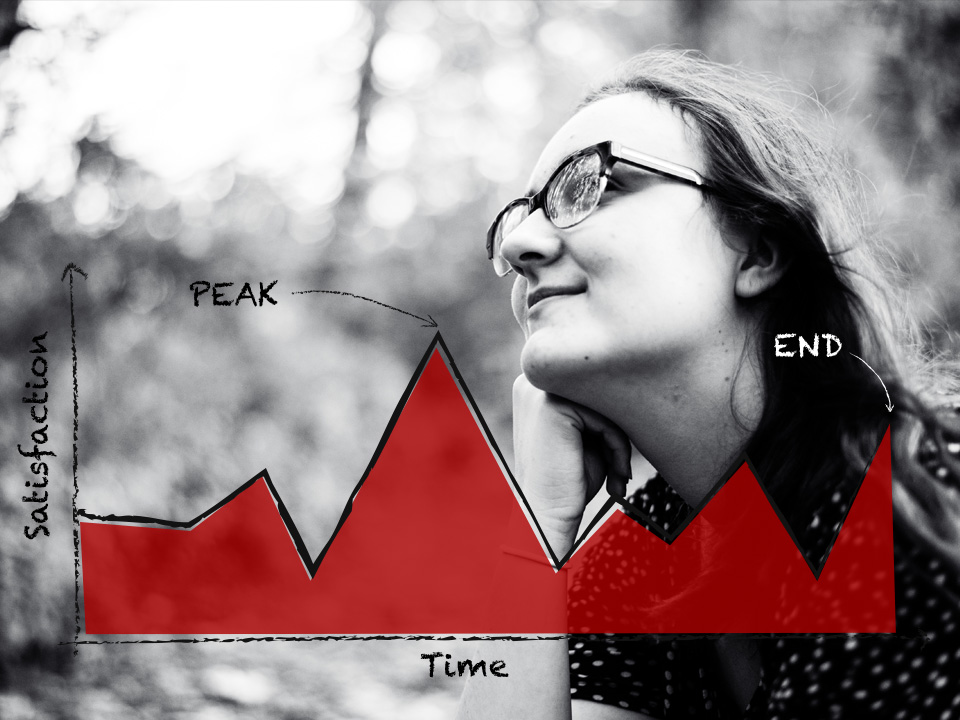
According to the Peak End Rule, we tend to judge an experience by its highs and lows (peaks) or the last part (end). Image credit: Alex Medick via Flickr.

According to the Peak-End Rule, we tend to judge an experience by its highs and lows (peaks) or the last part (end). Image credit: Alex Medick via Flickr.

All’s well that ends well

It turns out our memories are subject to something called the Peak-End rule. We don’t remember all parts of an experience equally. Instead, we tend to judge and remember experiences based on how they were at the end (and also at their most intense point), rather than on an average of the whole experience. The term was coined by Nobel Prize winner Daniel Kahneman, author of Thinking, Fast and Slow.

This rule suggests that you will remember even a painful or unpleasant experience more positively if the end of the experience is better relative to the rest of the experience.

Cold water

One of the first and most famous experiments highlighting the Peak-End Rule was published in 1993 under the title “When More Pain Is Preferred to Less: Adding a Better End”. The experiment involved subjecting people to the unpleasant experience of immersing their hand in very cold water. The first time around, people had to keep their hand in 14 °C water for 60 seconds. In the second trial, the same people did the same thing but then had to leave their hand in the water for an additional 30 seconds while the temperature was raised to 15 °C. The subject participants then had to choose which of the two trials they would prefer to repeat.

You might think people would obviously choose the first trial – 60, rather than 90 seconds of leaving your hand in uncomfortably cold water. But you guessed it: a significant majority said they would rather repeat the second trial. They chose more pain over less, but with a more pleasant ending.

Colonoscopies

Another study subjected colonoscopy patients to two different versions of this clearly unpleasant experience. Half the patients experienced a normal colonoscopy whereas the other half experienced a longer procedure but one that ended with three minutes that were less unpleasant than the rest. Essentially doctors left the tip of the scope in place without moving it. As a result, the last three minutes were less painful than the rest of the procedure.

As predicted, patients who rated the final few minutes of the colonoscopy as less painful and less unpleasant rated the entire experience as less unpleasant. Importantly, people were more likely to return for a follow-up colonoscopy if their overall memory was less unpleasant. Other research has also shown that people’s memories of painful medical treatments are strongly influenced by the level of pain experienced at the peak of the pain and during the last three minutes.

Childbirth

Many women say that while giving birth was the most profound experience of their lives, it was also the most painful. Does the peak-end rule apply here too? Researchers asked women in labour to rate their level of pain every 20 minutes from the time they arrived at hospital until the birth. The women were also asked two days later and two months later for an overall evaluation of the pain of childbirth using the same scale. And yet another tick for the peak-end rule. Women’s recollections of pain during childbirth after the event were largely determined by only two moments – the moment of peak pain and the moment of birth.

And prizes

And the peak-end rule doesn’t just apply to pain. Participants in a different kind of experiment were given free DVDs as a result of supposedly having won a raffle after donating to a charity. The DVDs given out were classed as more or less popular. People who received the more popular movies after the less popular ones were much more pleased with their raffle winnings compared to those who received the exact same DVDs in the opposite order.

Ending on a high note

So next time you’re planning a holiday or anything else that is likely to have highs and lows, plan for the best things to happen at the end. And don’t worry if things don’t go to plan. Chances are you won’t remember the bad bits anyway.

Now I just need to go on holiday so I can test the theory.

Links and stuff

Get out of my ear, damn worm

comments 10
Myths / Psychology

When I was sixteen, I spent a year living and going to school in Germany. Among other things, I fell for the German language… what’s not to love about the words weltschmerz, geschwindigkeitsbegrenzung, ahnungslosigkeit and the phrase das ist mir wurst? But one of my all-time favourite German words is Ohrwurm; translation ear worm!

Earworms: annoying song snippets that get stuck in your head. Image credit:

Earworms: annoying song snippets that get stuck in your head. Image credit: Sasha Wolf via Wikimedia Commons.

I just can’t get you out of my head

What’s an earworm? When you get a song — or typically just part of a song — stuck in your head. It’s an apt but somewhat unsettling image. I can’t help but picture a worm entering my ear and burrowing into my brain.

…this little fragment, often a bit of the chorus of the song, that just plays and replays like it’s stuck on loop in your head. Elizabeth Margulis, Director, Music Cognition Lab, University of Arkansas

The term ohrwurm was coined in 1979 by German psychiatrist Cornelius Eckert. Researchers call the phenomenon Involuntary Musical Imagery (INMI). Other names include tune wedgies, sticky tunes and stuck song syndrome. The Italians call them canzone tormentone – tormenting songs.

Ohrwürmer (earworms) aren’t necessarily good or bad songs, but they are catchy and tend to be extremely annoying because they are hard to get rid of. Research has found 91% of people have an earworm once a week, and a quarter of people have one once a day. Fifteen percent of people say they find earworms disturbing.

Interestingly, music pops into our heads unexpectedly and involuntarily much more often than visual images, words or smells.

The likelihood of getting an earworm seems to come down to three things: the music, the person and the situation.

What makes a good wurm?

Researchers at the University of London have found under the right circumstances, most songs can become earworms. But it is much more common for a song we know to get stuck. And songs with lyrics lodge in our minds much more often than instrumental pieces.

Earworms last between about eight and fifteen seconds and tend to follow a musical magic formula. The key components are musical notes with longer durations but short intervals between the notes (think of playing keys that sit close to one another on a piano). That’s not surprising given those features also make songs easier to sing. Earworms are also usually predictable but with enough variety to keep you interested.

Classic earworm songs are Starship’s We Built this City, ABBA’s Waterloo and The Baha Men’s Who Let the Dogs Out?

Think you’re immune to earworms? Press play, if you dare…

Why me?

Musicians experience more earworms than non-musicians — the act of practicing or performing music makes you more susceptible to getting a tune lodged in your head. People who believe music is important (even if they haven’t had any musical training) are more likely to get songs stuck in their head than people who don’t care as much for music.

And people suffering neuroticism and low levels of obsessive compulsion are also more likely to get frequent earworms.

Why now?

Unsurprisingly, if you have recently listened to a particular song, it is more likely to stick in your mind. Similarly, if you have heard a song repeatedly the chances are higher it will become an earworm. And of course if it is a song that is easy to sing, the act of singing it yourself makes it more likely the song will stick around even after you’ve had enough.

Memories can also have a lot to do with it. For example, being in a particular place may trigger an associated song to come into your mind.

If earworms are something that plague you often, it’s worth knowing we are all more likely to get stuck with an earworm when we are tired, stressed or bored. Research has found waiting in a queue is a very common time to develop an earworm.

How do you dislodge a worm?

There are two ways you can respond to having an earworm: you can try to distract yourself or you can simply cope.

Distraction might involve tackling a crossword or sudoku puzzle or starting a conversation. Coping probably means putting up with it until the worm disappears of its own accord.

Research published last year found that for many people there is a clear winner when it comes to strategies to get rid of an earworm. But it’s not going to be fun if the earworm happens to be a song you hate.

You have to tackle your earworm headfirst and listen to it intentionally. Better yet: sing it. Out loud.

So if you hear me belting out some ABBA, you’ll know what I’m trying to do. Wurm, be gone.

Links and stuff

Fun run, anyone?

comments 2
Health / Myths / Psychology

Do you find it hard to get enough exercise? Exercise plays a critical role in sleep regulation, maintaining a healthy body weight and overall mental wellbeing. But what goes through your mind when you’re on a run or sweating through a gym class? Are you having fun? Or are you pushing through because it’s for exercise? While the answer may seem irrelevant, your mindset actually has the power to completely derail your healthy goals.

Share the love: this post was written by science communication student Emma Giles.

You can probably remember a time when you exercised really, really hard. Perhaps you ran a gruelling race, or hiked up a mountain. Maybe you can recall your first spin class and how much harder it was than it looked.

If you think back to what inspired you to get started and keep going, there are two options.

One is you went into the activity for a non exercise-related reason. Maybe you were socialising with a friend, meeting new people, enjoying the view or some fresh air.

The other possibility is that getting exercise was the main thing on your mind: burning calories, losing weight or getting fit.

It turns out thinking of the activity in terms of exercise, rather than enjoying it for an unrelated reason, can have a very negative effect on the type and amount of food you consume afterwards.

How can exercise mindset play such an important role in your health successes? Researchers at Cornell Food and Brand Lab set up a series of experiments to investigate.

The secret to effective exercise: have fun while you're doing it! Image credit: Mike Boening Photography via Flickr.

The secret to effective exercise: have fun while you’re doing it! Image credit: Mike Boening Photography via Flickr.

A powerful intention

In the first study, the experimenters told participants they were going to take a walk. One half of the group was told the walk was for exercise, while the other half was told the walk was for pleasure.

The exercise participants were asked to record their energy level throughout the walk, while the pleasure participants were given music to listen to and asked questions about the music throughout the walk.

Afterwards, all of the participants were invited to an all-you-can-eat buffet. Here, the experimenters discovered something surprising.

When it came time for desert and drinks, the participants who were told the walk was for fun served themselves significantly fewer calories than the participants who saw the walk as exercise.

Even more, the exercise group rated themselves as more fatigued following the walk, despite the fact they performed the exact same activity as the participants who thought the walk was for fun!

Now, you’re probably wondering how this subtle difference could have such an effect. The answer lies in rewards.

The psychology of reward

It turns out just the thought of having performed physical activity makes us susceptible to wanting to compensate and reward ourselves for the hard work.

It’s called compensation. When you do something you don’t want to do, you find a way to ‘reward’ yourself. Professor Brian Wansink, Cornell University

After a hard workout, it’s easy to fall into this mindset and justify rewarding ourselves. And while there’s nothing wrong with a reward, it’s all too easy to overestimate how hard we worked and underestimate how much we are consuming when we treat ourselves.

This drive to reward ourselves with food is powerful, especially if we start to make it a habit. The brain actually contains an entire circuit devoted to rewards! And this circuit happens to be tied up with addiction pathways in the brain.

This means the brain is hardwired to become addicted to rewards. So each time we reward ourselves with food after a workout to compensate for our hard work, we strengthen these connections in the brain and it becomes harder to break the cycle.

Kicking the habit

So what can we do about this cycle?

The Cornell Food and Brand lab study shows the answer is simple. Simply performing exercise for pleasure seems to be all it takes to prevent that pesky feeling of needing to reward ourselves.

This is the perfect excuse to ditch any sport or activity you secretly dread but have been doing for the physical benefits. Instead, find something you love. It will be good for your mind and your waistline.

Links and stuff

Up all night, sleeping

comment 1
Biology / Health / Psychology

Pseudo-insomniacs are rare cases that complicate the classical rules of sleep science. While they perceive themselves to be awake all night, traditional lab tests show nothing other than completely normal sleep. ‘Pseudo-insomniacs’ have made scientists take a closer look at the sleeping brain, but the science of sleep is still far from being completely understood.

Share the love: this post by science communication student Lachlan Stoney

afkjsah. Image credit: Arne Coomans via Flickr (modified).

Some self-diagnosed insomniac are actually sound sleepers. But what causes pseudo-insomnia? And what can we learn about sleep by looking at the electrical activity of the brain? Image credit: Arne Coomans via Flickr (modified).

Do you lie awake at night, tormented by an inability to sleep? About 1 in 8 of us suffer some form of chronic or severe insomnia, making it a widespread and serious health concern. If you are especially unlucky, you might have the sort of insomnia that can’t be detected in a sleep clinic. This is the problem faced by about 5% of people who claim to have insomnia.

More than hypochondria?

Pseudo-insomnia, also known as ‘sleep state misperception’ or ‘paradoxical insomnia’, has usually been regarded as a psychological problem, or a type of hypochondria. People can easily overestimate how long it takes for them to get to sleep, and underestimate how long they sleep for. While this may be part of the explanation, some scientists believe that the lab tests may not be giving the full story.

So is there something unique about the brains of pseudo-insomniacs that distinguishes them from both normal sleepers and verified insomniacs? In order to help answer this question, scientists have been taking a closer look at the electrical patterns in the brain during sleep. But the answers aren’t exactly clear cut. Pseudo-insomniacs, if not hypochondriacs, may simply be blurring the distinctions between waking and sleeping. After all, there is currently no completely reliable way of identifying a sleeping brain from readings in the lab. Discovering an objective signature of sleep is still a holy grail of sleep science.

Decoding the brain’s message

Brain activity can be detected because it is fundamentally electrical in nature. Billions of cells in the brain are constantly exchanging electrically charged chemicals in a vast and intricate network which we are only beginning to untangle. The electroencephalogram (EEG) is the instrument that can detect large-scale patterns of this sort of electrical activity.

Scientists in the 1960s developed a series of rules for diagnosing different sleep states based on patterns seen on the EEG. For example, relaxed wakefulness is often accompanied by oscillations called ‘alpha waves’, which are just voltage variations in the EEG reading with a certain frequency range. ‘Delta waves’ are slower and larger, and tend to be associated with deep sleep.

Pseudo-insomnia is the exception to the rules, with non-sleepers showing plenty of delta wave activity. While this discrepancy has been known about since the 1970s, more recently sleep scientists have attacked the problem with a technique called ‘spectral analysis’.

Reading the fine print

Where a signal seems noisy or random to the human eye, spectral analysis provides an efficient and objective way to identify any dominant cycles.

Applying spectral analysis to EEG readings reveals some fine details that can be overlooked by the human eye. Relative to normal sleepers, the spectra of pseudo-insomniacs contain not only more alpha wave activity (wakefulness), but also more beta and gamma waves. The difference is subtle, but it is there.

The same pattern is also detected with many regular insomniacs, which makes it unclear whether pseudo-insomnia is really something unique.

Stress heads

So what does the presence of beta and gamma waves mean? Waves of this type have traditionally been associated with consciousness. When your brain is giving off these signals, you are likely to be actively concentrating, or feeling stressed and anxious.

Insomniac brains just can’t quite seem to turn off, and ‘pseudo-insomniacs’ may be no exception. Bizarrely enough, insomniacs have been documented to be better than the well-rested at learning new physical tasks, and display more activity in corresponding areas of the brain. The interpretation seems to be that insomniacs are in a constant state of information processing.

Blurring the lines

Depending how closely you look, pseudo-insomniacs can display brain activity similar either to normal sleepers or regular insomniacs. The take-home message might just be that our understanding of sleep is incomplete. The brain is a bafflingly complex system that we might never fully understand.

Links and stuff

Chocoholics rejoice! It’s (mostly) good news

comments 4
Health / Medicine / Myths / Psychology

We’ve all heard claims chocolate is healthy. But if you’re anything like me, you’ve wondered if that’s a vicious rumour started by a chocolate multinational. I’m delighted to tell you in fact scientists have found plenty of evidence for the health benefits of chocolate eaten in moderation. But there are a few things you need to know.

Just in time for Christmas... chocolate can actually be good for you.

Just in time for Christmas… chocolate can actually be good for you. Image credit: Austin Kirk via Flickr

A long but not so sweet history

The Latin name for cocoa, Theobroma, means “food of the gods”.

The word “chocolate” comes from the Aztecs and means “bitter water”.

It’s thought cocoa was first grown as a domestic crop by the Olmec Indians, and we have evidence cocoa was already being drunk in 1900 B.C.

Both the Mayans and Aztecs believed the cocoa bean, which is actually a seed, had magical (and aphrodisiac) properties. We know Aztecs even used cocoa beans as currency – one hundred cocoa beans bought a slave.

Cocoa was initially consumed as a bitter, unsweetened drink and it wasn’t until the 16th century that the Spanish began to add sugar.

The first chocolate bar as we know it was made in 1847, by adding melted cocoa butter back to the cocoa. Cocoa butter is a pale yellow fat extracted from the cocoa bean.

The extremely sweet milk chocolate we are all familiar with now bears little resemblance to the original bitter, frothy drink consumed by the Mayan and Aztec elite.

And therein lies a problem.

The darker the better

The milk chocolate that may appear in your Christmas stocking is more sugar than cocoa. The lower the percentage cocoa on the label, the more sugar has been added.

So when scientists say chocolate is good for you, they mean 70% cocoa (or higher) dark chocolate. If you’re a milk chocolate fan, sadly you’re getting lots of the bad stuff (sugar) and not as much of the good stuff (cocoa).

You should also know that in cheaper chocolates, the healthy cocoa butter is replaced by less healthy vegetable (often palm) oil. There are many reasons we should avoid eating palm oil.

Chocolate really is good for you

Aside from the fact dark chocolate is loaded with minerals, it also contains a number of different compounds with proven health benefits.

In particular, dark chocolate is one of the highest food sources of polyphenols, which are nutrients known to play a role in the prevention of cancer and cardiovascular disease.

Daily consumption of small amounts of dark chocolate reduces blood pressure and reduces the risk of heart disease.

Research out this year suggests that particular bacteria in our stomach digest dark chocolate and ferment it into anti-inflammatory compounds that are really good for our hearts.

Eating chocolate also decreases our risk of stroke. One study of 44,000 people found people who ate chocolate every week had a 22 percent reduced risk of suffering a stroke compared to people who didn’t eat chocolate.

Dark chocolate also increases levels of the HDL (good) cholesterol and reduces the level of LDL (bad) cholesterol.

Eating dark chocolate rich in polyphenols may prevent or at least delay the onset of diabetes because it improves our sensitivity to the hormone insulin.

And if all of that isn’t enough, the cocoa polyphenols reduce anxiety and promote feelings of calmness and contentedness.

Flavonoids are a type of polyphenol that act as antioxidants, protecting our cells against damage and are found in the high amounts in unsweetened cocoa powder and dark chocolate. Flavonoids are responsible for dark chocolate’s bitter taste.

Flavonoids have been shown to enhance memory in rodents and also in people (but only in very high amounts).

Another study found memory, impulse control and reaction times all improved after eating chocolate.

I also can’t resist sharing with you the fact that the more chocolate people in a given country eat, the more Nobel prizes that country has won, with Switzerland topping the list for both. Hmmm, correlation versus causation anyone?

There’s even some truth to the idea that chocolate is an aphrodisiac. Women who consume chocolate daily have significantly higher libidos than those who don’t eat chocolate.

Want more good news? There’s evidence dark chocolate may prevent skin cancer and that theobromine, another bitter-tasting component of cocoa can prevent dental cavities.

The key to all of these health benefits is to eat dark chocolate that has been minimally processed given that processing can take out some of the healthy components.

And don’t eat too much of it – studies recommend anywhere from six to forty grams per day. You’ll be pleased to know dark chocolate is more filling than milk chocolate, so eating dark chocolate reduces our cravings for other sweet foods.

Ok, what’s the bad news?

The bad news is that the ongoing sustainability of the world’s cocoa crop is at risk.

Some think chocolate will become a luxury item within ten years which would be a return to where it all began with the Aztecs – a food only available to the wealthy. Chocolatier Drew Maddison, The Ministry of Chocolate

The cocoa tree is native to the tropical rainforests of Central and South America, only growing in a band 20 degrees north or south of the equator. Seventy percent of the world crop grows in West Africa and ninety percent is grown by small-scale family farmers.

A cacao pod like this one might contain 20 to 50 cocoa beans; enough for about 30 grams of chocolate. Image credit Bobby Neptune / USAID via Flickr

A cacao pod like this one might contain 20 to 50 cocoa beans; enough for about 30 grams of chocolate. Image credit Bobby Neptune / USAID via Flickr

Cultivation of cocoa is an extremely delicate process – the trees are susceptible to temperature changes, drought, excessive rain, wind, insects and diseases such as Witches’ Broom and Frosty Pod Rot. All of these factors reduce the yield from a cocoa plantation.

As a result, climate change looms as a major threat to chocolate production.

Another issue is that cocoa farmers make the same amount of money by farming rubber instead of cocoa and rubber is a much easier crop to grow and manage.

Today, 3.5 million tonnes of cocoa are produced every year, but those in the industry predict the demand will be 4.5 million tonnes as soon as 2020.

We’re running out of chocolate? Hit the panic button now!

Links and stuff


May your Festive Season be filled with a suitably healthy amount of chocolate and I hope you have many relaxing days ahead with family and friends.

Thanks so much for your support of Espresso Science over the last six months. I’ve had a blast and will be back with more Shots of Science in 2015.

Animals have talent

comments 3
Biology / Evolution / Zoology

Chimpanzees use blades of grass to ‘fish’ for termites, and capuchin monkeys use a hammer and anvil to crack open nuts. A mandrill has even been seen using a stick to get dirt out from under his toenails. We’ve known for a long time that other primates use tools but how about animals that aren’t our close relatives?

In his 1871 book The Descent of Man, and Selection in Relation to Sex, Charles Darwin retold a tale of Gelada baboons rolling large stones down a hill to ward off other baboons and people.

The baboons in return rolled so many stones down the mountain, some as large as a man’s head, that the attackers had to beat a hasty retreat. Charles Darwin, 1871

Just a story? Researchers working in Africa in the 1970s were also ‘stoned’ by baboons.

Jane Goodall and others have observed an amazing array of tools being used by chimpanzees. Chimps use tools to collect honey, crack open nuts, and use leaves and moss as sponges to soak up water for drinking. Chimps have even been observed fashioning spears to hunt other primates.

Using tools is well known in orangutans, gorillas, and a variety of other primates. One of my favourite examples is a gorilla using a walking stick to work out how deep a pool of water is. Another is long-tailed macaques at a particular Buddhist shrine in Thailand using human hair like dental floss.

Only in primates?

While we aren’t too surprised brainy primates use and even make tools, we have found it harder to stomach the fact that heaps of other animals are also tool users.

Among mammals, there are well-known examples like sea otters using rocks to crack open shellfish and elephants using branches to swat flies. Kandula, an Asian elephant at the Smithsonian Zoo has become famous for his problem-solving abilities. He uses a plastic cube to get to food that would otherwise be out of reach. Kandula is a YouTube hit.

In Shark Bay, dolphins wrap pieces of sponge around their noses as protection for when they are hunting on the sea floor.

But tool use is certainly not just the domain of mammals.

All sorts of animals use tools. In Japan, crows drop nuts

All sorts of animals use tools. In Japan, crows have learned to drop nuts ahead of oncoming traffic, and then to watch for the red traffic light to retrieve their freshly-cracked treat! Image credit: Y Kanazawa via Flickr

Crows, traffic lights and drumming cockatoos

Birds have a reputation for being very brainy, with good reason. There are many examples of birds using tools. Burrowing owls collect mammal poo to attract dung beetles, which they like to eat.

Crows are known to be good at dropping nuts with hard shells from great heights in order to crack them open. But, of course, this comes with a risk – dropping a nut from high up means another bird might get to your freshly-cracked nut before you can. The solution? Find a more efficient way to crack the nut.

Crows in Japan have learned to drop nuts on roads where cars will do the cracking for them. They wait for the traffic light to turn red so they can retrieve the tasty nut in safety. David Attenborough describes it beautifully.

Male palm cockatoos carefully craft drumsticks to perform a rhythmic drumming solo at their nest. Why? To impress the ladies of course. Watch the percussive parrots here.

Even reptiles use tools

Not that long ago, people would have scoffed at the suggestion that ‘primitive’ animals like reptiles use tools. Incredibly, crocodiles and alligators today aren’t that different from their ancestors that lived 200 million years ago.

But last year, researchers reported on crocodiles and alligators putting sticks on their heads (very close to their fearsome mouths) to lure unsuspecting birds like egrets. The crocodiles and alligators display the sticks only during the breeding season of the wading birds, when the birds collect sticks to build their nests. Not only is this the first account of a reptile using a tool, it’s also the first time we’ve seen a predator time the use of a lure around the seasonal behaviour of their prey. You can watch this fearsome trickery here.

Creatures great and small

For a long time humans liked to think we were the only animals ‘intelligent’ enough to use tools, but it turns out we were wrong. Even ants have been seen using tools of a kind. One type of desert ant drops small stones down the entrances of nearby nests of other ant species, trapping the other ants. A nifty way of ensuring the jailors get all the food.

So many animals are handier than we thought. Even some that don’t have hands.

Links and stuff


Videos

I’ve collected some of my favourite videos of animals using tools. Check them out in this YouTube playlist.


Get lost! Are men really better navigators?

comment 1
Anthropology / Evolution / Myths

Yes, men are better than women at spatial awareness. There, I said it. As a result, men tend to be better navigators. But why?

For decades, psychologists have looked for differences in the way male and female brains work. And genuine differences have been hard to find. But when it comes to tests of spatial awareness, men do significantly outperform women. Obviously there are plenty of individual women who perform better on these tests than men, but on average, men are statistically more accurate than women.

Sorry girls, science says mean are better navigators.

As much as it pains me to admit it, the science says men are better navigators. Image credit: Marcus Ramberg via Flickr

Rotate things… in your mind

Put simply, spatial awareness is the ability to recognise and visualise spatial patterns and manipulate them in your mind. A classic test of spatial awareness is showing people an object and asking them to visualise what it would look like when rotated 180°. Men are generally quicker to perform this mental rotation. This male advantage is true across cultures, in 4-year olds and even babies. And this spatial ability is strongly related to navigation skills.

At the same time, women are better at what’s called object location memory – recalling the specific location of an individual object.

There are two main arguments for these gender differences: evolution and hormones.

Evolution: hunters and gatherers

Researchers have explained why men have better spatial skills by looking at the different roles men and women have played during our evolutionary history. In human societies during the Pleistocene, men ranged far and wide while hunting whereas women were responsible for gathering food closer to home.

It was advantageous for men to be good at mentally picturing a landscape from different perspectives so they didn’t get lost. At the same time, it was useful for women to be able to locate particular plants year after year during their growing seasons.

There is modern research to back these arguments. For example, when you ask men and women how they navigate to new places, men tend to fall back on their innate sense of direction, whereas women often rely on maps or other instructions. Men maintain a sense of their own position relative to cues in the environment around them. Research shows that although men are quicker to find new places, women are better at finding them again at a later time.

But one of the problems with this explanation is that the tendency for males to be better at spatial tasks is found in a variety of animal species. And although it’s common across a variety of animals for males to travel further in their day-to-day lives than females, that’s not always the case.

If the tendency for males to explore more widely than females was enough to explain the differences in spatial skills, then males of species that range the widest should have the best spatial skills. In species where males and females travel about the same distances, neither sex should have an advantage in spatial tasks.

But that’s not what we see. Research published in 2012 looking at 11 species of animal, including rats, humans, horses and cuttlefish found no relationship between the distances covered by males (compared to females) and their spatial skills. So what else could explain the male navigational advantage?

Hormones: perhaps testosterone is the answer?

We’ve known for a century that in rats, males are better than females at finding their way through mazes. Interestingly, male rats aren’t very good at navigating mazes if they’ve been castrated. But if you give them a dose of testosterone, the rats regain their competitive edge.

The researchers who looked at horses and cuttlefish propose that the superior navigational ability of males is simply a “side effect” of males having more testosterone. They argue that the evolution argument doesn’t stack up because women would have inherited the same navigational skills as men unless it were somehow bad for them. And it’s hard to imagine why good navigational skills would be a bad thing for women.

So if we see something that’s advantageous for one sex, the other sex will get it because it’s inheriting the same genes – unless it’s bad for that sex. Psychology Professor Justin Rhodes, University of Illinois

Does it all come back to sex?

The most recent addition to this debate comes from studying two tribes living in mountainous deserts of north-west Namibia, the Twe (pronounced tway) and Tjimba (pronounced chim-bah). Men in these tribes travel widely, at least partly as a way of finding new sexual partners (affairs outside marriage are accepted in this culture).

Men in these tribes who did the best on a variety of spatial tests traveled considerably further than other men. Not only that, but these men also fathered more children than other men in the tribes. Good navigators having more kids provides nice support for the evolutionary argument.

Whatever the reason, I’m going to stop getting frustrated by the fact my husband is a much better navigator than me. It’s not my fault!

Links and stuff