A baby with a cure?

Leave a comment
Biology / Medicine

In 2010, a woman who had received no pre-natal care arrived at a hospital in rural Mississippi already in labour. Tests revealed she was HIV (human immunodeficiency virus) positive. She gave birth to her baby girl before medication could be given which may have prevented the transmission of the virus from her to her baby.

If a mother is known to carry HIV, medication during pregnancy can reduce the risk of transmission from up to 45% down to less than 2%.

The 10th annual AIDS conf

Melbourne hosts the 20th International AIDS Conference this week. Image credit: Scott Cresswell via Flickr

Positive

They tested the baby for HIV at 30 and 31 hours of age and the results came back positive; the baby had HIV. From 30 hours of age, the baby was put on an aggressive treatment regime.

Tests at six, 11 and 19 days all came back HIV positive too.

But at 29 days of age, levels of HIV in the baby were suddenly so low that the virus could no longer be detected by standard tests. The baby wasn’t breastfed and she continued to be given medication. At 18 months, doctors declared her still effectively HIV negative.

Then the mother and baby disappeared out of the medical system and doctors later found out that she stopped taking any medication at 18 months.

Cured!

Everyone was astounded when she reappeared just before turning two and still tested HIV negative. At two and a half, a full year after she had stopped taking medication, her HIV levels were still below detectable levels.

In all of these tests, although traces of the virus were still detectable, levels were so low that she was considered ‘functionally cured’. A functional cure means the virus is kept at bay without any treatment.

This was in early 2013 and it made big news. For the first time a baby had been cured of HIV. Seriously exciting!

The Berlin patient

Only one other person had ever been functionally cured of HIV, the so-called Berlin patient. His cure resulted from radical treatment for leukemia in which doctors pretty-much destroyed his immune system. A bone marrow transplant brought him back to health and importantly, this transplant came from a donor with a rare natural resistance to HIV infection.

People with this resistance are called elite controllers or long-term nonprogressors and are thought to include 2–4% of HIV sufferers.

The life-threatening and expensive Berlin patient procedure is not an option for the rest of the world’s 35 million HIV sufferers but here was a suggestion that an HIV cure may be possible. And everyone agreed that understanding exactly what had gone on with Mississippi baby might be a step towards this cure.

Hide and seek

One of the reasons curing HIV is proving so hard is because the virus lies dormant in the body, in hiding from all of the treatment options we currently have. As soon as the drugs stop, the virus reemerges. Scientists wondered if this time they had managed to kill off the virus before it could establish and go into hiding.

It was full-steam ahead for a major study of HIV treatment in infants until a couple of weeks ago.

A punch in the gut 

On 10 July, news broke that after 27 months of no medication, the Mississippi baby who is now nearly four year sold, once again has high levels of HIV in her body. At the same time cells that indicate a normally functioning immune system (CD4+ cells) have dropped. This means the virus is having an effect on her health, rather than simply lying dormant.

She had been monitored every six to eight weeks for 18 months and no one knows why the virus has suddenly reemerged now. Back on medication, her immune cell levels are recovering but the big questions are where did the virus hide? And why did it hide for so long?

Sadly the Mississippi baby now faces a lifetime of medication but scientists argue that despite her HIV reoccurrence being like a ‘punch in the gut’, there is still much we can learn from her. I guess time will tell.

This week, the 20th International AIDS Conference is running in Melbourne.

Links and stuff

Be regular my beating heart

Leave a comment
Biology / Health / Medicine

Thanks to a specialised group of cells called pacemaker cells, your heart keeps beating, and at a regular pace. There are a few thousand of these cells in your heart and they send out the electrical signals that initiate each heartbeat.

But if you suffer from a condition called heart block, these signals are disrupted and your heart may skip beats or beat too slowly. These abnormal heart rhythms may just leave you feeling light-headed and woozy but they may also lead to full-blown cardiac arrest. This is when the heart doesn’t contract properly and the brain and rest of the body don’t get enough oxygen delivered to them. Without fast treatment, brain damage can occur.

Enter the man-made pacemaker

Heart block can occur at any age, even in unborn babies, and current treatment is to fit an electrical pacemaker device. The pacemaker monitors the heart’s rhythm and if the heart slows down or skips a beat, the pacemaker sends out an electric pulse to get the heart back on track. This surgery obviously isn’t an option for an unborn baby and heart failure due to heart block is thought to be the cause of some stillbirths. Even in adults, pacemakers last only seven years and the process of implanting the device carries its own risks, mostly of infection. This week, researchers from the Cedars-Sinai Heart Institute in Los Angeles announced in the journal Science Translational Medicine that they had used a gene called TBX18 to coax ordinary heart cells into becoming new specialised pacemaker cells. TBX18 usually plays a role during development before birth, when the heart’s original pacemaker cells are being formed.

Electronic pacemaker. Image credit: Steve Wintor [CC] via Flickr

Electronic pacemaker. Image credit: Steve Winton via Flickr.

Pig pacemakers

Researchers injected the gene into the hearts of pigs with heart block (pigs hearts are very similar to human hearts). Within 48 hours, this little patch of cells, about the size of a peppercorn, had begun to act as pacemaker cells, delivering electrical signals to the rest of the heart. And the process of injecting the gene wasn’t anywhere near as invasive as the surgery required to fit a pacemaker and could conceivably be done to an unborn baby. They only monitored the pigs for the next two weeks but during that time the new pacemaker cells kept working and the scientists are hopeful that the cells might keep doing their new job permanently. The aim is to be trialing this technique, dubbed the biological pacemaker, in humans within three years. This is a very cool example of what’s called gene therapy — using DNA effectively as a drug to treat disease. Let’s hope those pigs’ hearts stay regular.

Links and stuff

The ultimate mix tape

comments 2
Astronomy / History / Physics

Did you ever make mix tapes of your favourite songs? It was a major hobby of mine, and the songs I included changed constantly. But what if you got to create the mix tape of all mix tapes, one that would last for one billion years?

Extended missions H2

In 1977, NASA launched two Voyager space probes as part of the Voyager Interstellar Mission and they set off on tours of the Solar System. Voyager 1 travelled to Jupiter and Saturn and sent back swathes of scientific data and colour photos in 1979 and 1980. Then it began its ‘Extended Mission’: Voyager 1 is now 19 billion kilometres from earth. In fact it is the furthest human-made object from earth and is no longer in our Solar System. It’s still sending back radio signals and they take 17 hours to reach earth, despite travelling at the speed of light.

Meanwhile Voyager 2 toured past Uranus and Neptune (it is still the only spacecraft to have visited these planets) and is now also approaching the edge of the Solar System. It continues to communicate with Earth and is expected to keep transmitting weak radio signals until at least 2025.

On current estimates, it is going to be about 40 000 years before Voyager 1 goes anywhere near another star (and more than double that for Voyager 2) but they are carrying some very important cargo.

The Golden Records

Attached to the outside, both Voyager 1 and 2 carry a ‘Golden Record’ – a gold-plated copper 33⅓ RPM record.

Carl Sagan and his team created these records in an attempt to encapsulate the essence of earth and humanity for whoever might find them in the future. They were designed to last a billion years.

The Golden Records are effectively time capsules, recording the human experience and life on earth. Who do we think will ever listen to them? Either humans of the future, or intelligent extra-terrestrials.

One of two copies of the Voyager Golden Record, the first of which was launched with the Voyager 1 probe on September 5, 1977.

Do alien life forms have turntables? Or do they just stream from the cloud? One of two copies of the Voyager Golden Record, the first of which was launched with the Voyager 1 probe on 5 September 1977. Image credit NASA/JPL via Wikimedia Commons.

Humanity in 33⅓ RPM

What’s on the Golden Records? First of all, 116 images (in analogue form). Some are scientific, showing chemical compositions, measures of mass and scale, planets of the Solar System, DNA and human anatomy and reproduction. There are also pictures of animals, plants, landscapes, people from a variety of cultures and examples of human architecture including the Sydney Opera House.

A whole lot of sounds made the cut: surf, wind, thunder, whale song, an elephant’s trumpet, a kiss, laughter, morse code and a mother’s first words to her newborn. (For the record, I reckon they could have chosen a nicer example of that: the baby is crying and the mother says ‘oh come on now’.)

Come and visit

The records include greetings in 55 languages – everything from Ancient Greek and Latin through to the most commonly spoken languages today. Some are very simple: ‘Many greetings and wishes’ in Italian and ‘Please be well’ in Korean. The English message is ‘Hello from the children of planet earth’. My personal favourite is ‘Friends of space, how are you all? Have you eaten yet? Come visit us if you have time’ in the Chinese dialect Amoy.

There is a written message from Jimmy Carter, then US president:

This is a present from a small distant world, a token of our sounds, our science, our images, our music, our thoughts and our feelings. We are attempting to survive our time so that we may live into yours. This record represents our hope and our determination and our goodwill in a vast and awesome universe.Jimmy Carter

Tunes

Last of all there is an eclectic 90-minute music mix including Bach, Beethoven, Mozart, Louis Armstrong and Chuck Berry’s Johnny B Goode, as well as traditional music from around the world. Sagan requested the Beatles ‘Here Comes the Sun’ and the band happily said yes. Ironically, EMI said no – I guess they had copyright concerns!

I’m never going to know if anyone ever finds or listens to these records but I love the idea that they are out there. The mind boggles imagining a scenario in which aliens try to make sense of us based on these sounds and images.

But the big question is: what would you put on your ultimate mix?

Links and stuff

What did your Grand­father eat?

Leave a comment
Biology / Evolution / Genetics / Health / History

Our story takes place in the northernmost county of Sweden, in a picturesque collection of villages beside the river Kalix. These days about 3,700 people live in Överkalix, descended from 15th century settlers.

It is a tough place to live. When I say north, I mean north – north of the Arctic Circle. For six months of the year, the sun barely rises. Historically, people survived by fishing for salmon, keeping livestock and depended on the annual harvest of barley and rye to get though the winter.

Looking back, you can see a clear boom and bust cycle of crop success. In 1799, 1801, 1813–15, 1822, 1825–26, 1841, 1853 and 1879, the long growing days of the far-northern summer resulted in huge surpluses of food and the people of Överkalix gorged themselves.

But equally unpredictably, years of total or near total crop failures followed especially harsh winters. People didn’t starve to death; they hunted small birds and made bread from the inner bark of fir trees. But it was certainly slim pickings – only a tiny fraction of the normal amount of food was available.

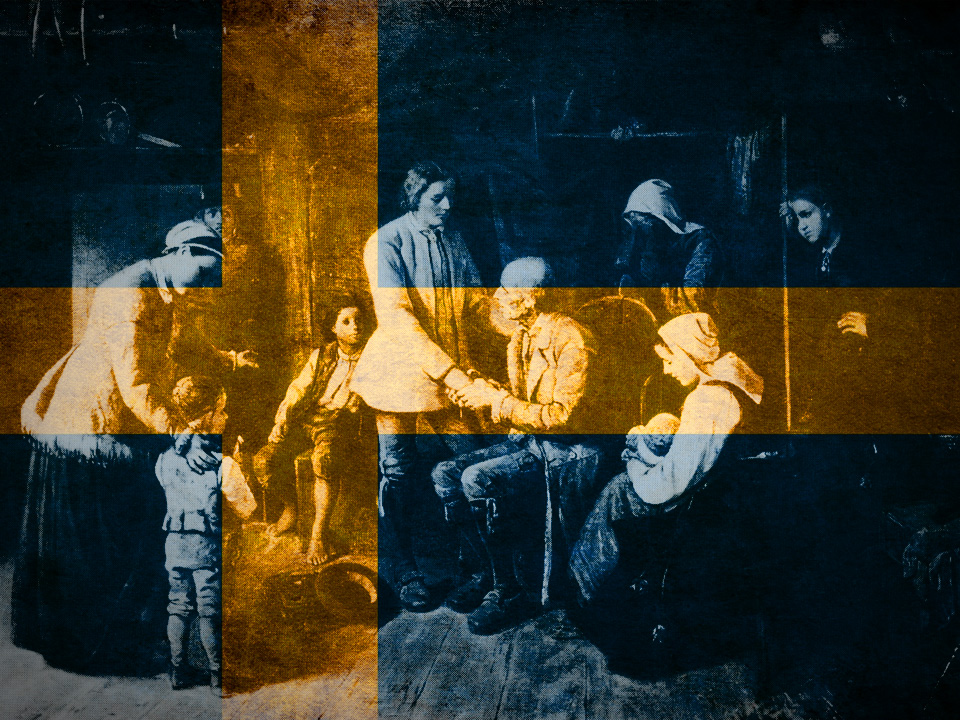
What can the records of 19th century swedes tell us about Image:

What can the records of feats and famine from 19th century Sweden tell us about epigenetics? Background Image: ‘The Emigrants’ by S. V Helander via Wikimedia Commons

How do we know?

Clergymen and other officials in Överkalix have kept meticulous records of every harvest for three centuries now. By adding other information like food prices, scientists have been able to reconstruct the nutrition available to generations of Överkalix families.

Why do we care about the nutrition of 19th century Swedes?

Because the same clergymen kept detailed records of every birth, death, cause of death and family lineage during the same period. What this amounts to is an incredible natural experiment allowing us to ask the questions “What are the life-long health effects of starvation and over-eating?”

And this is where our story gets interesting.

Imagine you are a boy growing up in Överkalix and between the ages of nine and twelve you experience at least one season of famine. You go on to have sons and grandsons. It turns out that your grandsons receive a significant health boost from your suffering. They have only one-quarter the risk of developing heart disease, a lower chance of developing type 1 diabetes and on average, live 30 years longer than if their grandfather experienced a season of feasting at the same age. That’s not a typo — I really mean 30 years!

The reverse is also true. If your grandfather experienced at least one season of feast, the effects on your health are negative. For example, you have a 400% increased risk of dying as a result of type 1 diabetes. All because your grandfather experienced one season of starvation or gluttony just before puberty.

Think I’m making it up? Could these crazy results be true?

What’s going on just before puberty?

It turns out they are. The ages of nine to twelve are known as the “slow growth period” in boys. On the outside not much is happening other than the fact that boys suddenly stop growing taller. But on the inside lots is going on and we know that environmental factors can have a big effect on the body. In particular, boys at this age are putting aside the cells that will later become sperm cells. And the experience of famine or feast is chemically marking these cells and the marks are being carried down through generations.

It took a long time for these results to be accepted by the scientific world. The story had always been that you were born with your DNA (half from your Mum, half from your Dad) and your DNA was your blueprint.

The Överkalix story (and many others now) tells us that even if your DNA sequence essentially doesn’t change during your life, there can be changes in the activity of our genes and they can be passed down through generations.

This is the science of epigenetics – literally: above genes. Think of your DNA as the hardware and your epigenome the software.

Basically, there is a system of switches that can turn genes on or off controlled by environmental factors like nutrition.

So is it good or bad news for us? Probably both. It means lifestyle choices you make like smoking and over-eating aren’t just affecting you, they may also predispose your kids and grandkids to disease and early death before they are even born. No pressure…

But equally, our choices now could leave a pretty amazing legacy.

Links and stuff