A trick of the light?

comments 5
Health / Medicine / Myths / Psychology

Did you know the winter blues, aka Seasonal Affective Disorder, can be treated with light therapy? You’re probably aware that the blue light emitted by your phone and computer may be wreaking havoc with your sleep. But could light also be affecting your health and mood in other ways?
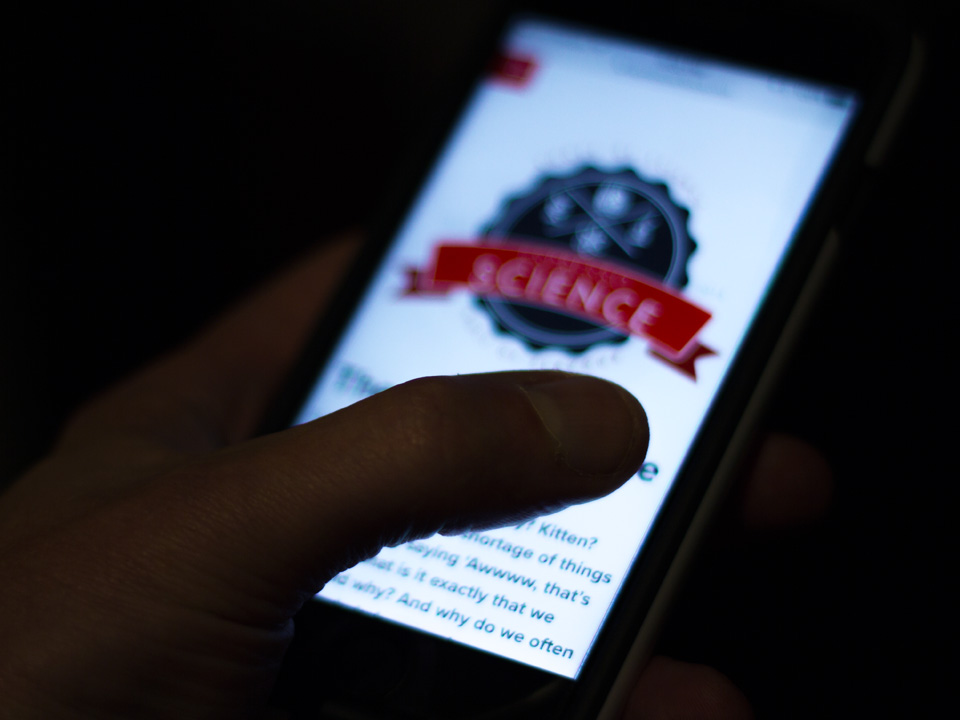
Is your smartphone affecting your sleep?

Could your smartphone be wreaking havoc with your sleep cycle?

Let there be light

Danielle Feinberg, Pixar’s director of photography, argues that light is the magical ingredient that brings animated worlds to life. For example, without careful attention to lighting, WALL-E is just a metal robot, not a lovable personality with a soul. Yet light is such a fundamental part of our lives that we tend to take it for granted.

The sun rises and light floods our world. After sunset, we flick on a light switch anytime we want to. It’s easy to forget light has a profound effect on our brain, body rhythms and overall health. Light obviously allows us to see, but our eyes also have light-sensitive cells that have nothing to do with vision. Instead, they send information about light levels to our brain, controlling our 24-hour body clock, triggering us to be alert and playing a role in our short-term memory.

Exposing our bodies to irregular light cycles affects our mood and brain function. The most well-known example of this is Seasonal Affective Disorder (SAD), a pattern of repeated depression that occurs during autumn or winter in up to 9% of people. There is some evidence that exposure to bright light improves this form of depression although a study published earlier this year questioned the existence of SAD.

The dark side of light: red, white and blue

If you live in a city, one of the most obvious aspects of light is that it’s virtually impossible to escape. Research out this week – the atlas of artificial night sky brightness – brought the depressing news that more than 80% of the world lives under light-polluted skies. Gone are the days of navel-gazing under a starry sky – more than a third of people can no longer see the Milky Way because the night sky where they live is so artificially bright.

There has been plenty of research looking at the health effects of light pollution. Essentially, being exposed to light at night completely stuffs up our body clocks with flow-on effects such as depression, cancer, weight gain and learning difficulties. How? Being exposed to artificial light at night suppresses production of the hormone melatonin, which we need to regulate our natural body rhythms.

Of course, artificial lights come in different colours and chances are you’ve heard that the blue light streaming out of your smart phone, or tablet, or computer, is particularly bad for you at night. During the day, being exposed to blue light makes us alert, better able to pay attention and faster in our reaction times.

But at night, blue light is the most powerful at suppressing melatonin. In one study, people were asked to read either a printed book or e-book for five nights in a row. Those who read the e-book had a delay in melatonin release of more than an hour and a half, they took longer to fall asleep and were less alert in the morning. This research has led to the popularity of plenty of programs and apps that reduce our exposure to the blue light of our screens. White light is somewhat better and red light, the least disruptive at night.

Mood lighting

If I say mood lighting, you probably think of dimly-lit lamps. And with good reason: there’s strong evidence that brightness of lighting affects our moods. Bright street lighting makes us feel safe and something as simple as having access to a window at work can result in better sleep and a better quality of life. At work, we feel happiest when our office lights are neither too bright nor too dim. Sunshine makes us feel optimistic and can even influence the stock exchange.

But there’s more to it than that. Under bright light, we feel warmer, regardless of temperature. And the more intense the lighting, the stronger our emotional response. Under bright lights, we judge attractive people to be more attractive, positive words to be more positive, and negative words to be more negative. In bright lights, we also choose the spiciest foods!

Ambient lighting also influences how calm we feel. It’s not surprising then that airlines are now investing in mood lighting for cabins: no more instantaneous changes from dark to bright lights on a long-haul flight when the aim is to calmly get breakfast into you before landing.

And mood lighting isn’t just for us: farmers have found mood lighting makes for ‘relaxed, happy chickens.’ That’s something to crow about!


Links and stuff

The science of cute

comments 4
Anthropology / Evolution / Psychology

As cute as a…  button? Puppy? Kitten? Panda cub? There’s no shortage of things we respond to by saying ‘Awwww, that’s so cute’. But what is it exactly that we find cute, and why? And why do we often feel an overwhelming urge to squeeze cute things?

Oh kawaii desu ne!? Japanese have taken cute to a whole new level. Image credit Tomohiro Ohtake via Flickr

Oh! kawaii desu ne!? Japanese have taken cute to a whole new level. Image credit Tomohiro Ohtake via Flickr

Kawaii

Baby animals, in particular mammals, rank high in the cuteness stakes. When twin baby pandas were born last year at the National Zoo in Washington D.C., 868,000 people watched panda cam over one weekend. There are more ‘cute baby animal’ websites than you could ever have time to look at and Buzzfeed even attempted a definitive ranking of the cutest baby animals. In case you’re wondering, baby otters beat puppies, kittens, and panda cubs to claim ultimate cuteness. Check out #CuteOff on Twitter if you want an overdose of cuteness.

Unsurprisingly, there’s money to be made out of cuteness: advertisements featuring cute children or animals abound. Cute soft toys are a massive industry and we can trace how these soft toys have become cuter over time. During the 20th century for example, the humble teddy bear changed from having a long snout to bearing a short snout and high forehead. Similarly, Mickey Mouse changed over a 50-year period – ending up with a larger relative head and far bigger eyes. These days, it’s hard to think of a Disney or Pixar character that doesn’t have enormous eyes. Whether on a mermaid, princess, fish, ant, monster, emotion, car or robot, the eyes are gigantic.

Whether you’re talking anime, manga or Pokémon, popular Japanese characters also tend to have exaggerated features, in particular, large eyes. Japan has taken the worship of cute to a whole new level. Ever since Hello Kitty said her first hello in 1974, Kawaii (translated these days simply as cute, loveable or adorable) has become a mainstay of Japanese popular culture. But what defines cute?

Baby face

It’s not just huge eyes that cute things share. There are a number of other features we associate with cute: a large head (Hello Kitty’s head accounts for half her body), a small ‘button’ nose, chubby cheeks and a prominent forehead. Research across cultures and races has shown this combination of characteristics is considered near universally adorable. Why have we evolved to respond so strongly to this set of facial features? Because these are the features of human babies.

Back in 1943, Konrad Lorenz dubbed this set of features the baby schema. Research in the 1970s showed we rate babies with the more pronounced of these features most attractive, that we like to look at cute babies, and babies make us smile. Lorenz argued that these physical features have come to signify vulnerability and prompt our parental instincts. Essentially, we are hardwired to want to nurture cute things. It makes sense: if we hadn’t evolved to be compelled to take care of our completely helpless newborn babies, humans probably wouldn’t have lasted long. Interestingly, although men and women are equally good at picking the age and facial expressions of babies, women are much better at rating different levels of cuteness.

And you don’t have to be a parent to feel this overwhelming desire to take care of a cute baby. Recent research recorded what was going on in the brains of women who had no children as they looked at photos of cute babies. The photos activated parts of the brain involved with our reward centres: we really are primed to respond to cute.

Care, concentration… and bubble wrap

Seeing something cute doesn’t just make us want to care for a baby. We know looking at cute things makes us feel more positive. I’m not kidding: research found that watching Internet cats makes you happier. And research has also shown that looking at cute images makes us pay more attention to detail, narrow our focus and behave more carefully. Yes, that’s right – checking out cute pictures on Instagram can improve your concentration and may even make you work more productively.

But contrary to what you might expect, cute things can also make us feel aggressive. Have you ever had the urge to pinch the chubby cheeks of a cute baby? Squeeze a kitten within an inch of its life? Given that cute things are often vulnerable, or fragile in some way, it seems odd they can lead us to say ‘you’re so cute I want to eat you up!’ Researchers suggest the aggression results from frustration: we can’t satisfy our intense desire to care for the cute thing in front of us which leads to an aggressive response.

And just in case you’re wondering, yes, scientists have carried out the ultimate experiment. Looking at adorably cute pictures makes us pop more bubbles on a sheet of bubble wrap.

Links and stuff

Love at first whiff?

comments 2
Anthropology / Biology / Evolution / Myths / Psychology / Zoology

Have you ever been to a pheromone party? The idea is to find your perfect partner based on smell. That’s right, body odour, and there’s no deodorant allowed. Pheromones are very particular smells: chemical signals animals evolved to communicate with one another. We know pheromones play a key role in the animal world, but scientists are arguing about whether the same is true for us.

Bombykol, the first pheromone to be identified chemically, is used by male silkworm moths to attract mates. Image credit: Nikita via Flickr (modified)

Bombykol, the first pheromone to be identified chemically, is used by female silkworm moths to attract mates. Image credit: Nikita via Flickr (modified).

Bombykol

The first animal pheromone was identified in silkworm moths, back in 1959. The pheromone was christened bombykol, and its discovery was the result of 20 years of painstaking work. Scientists had long suspected a chemical was responsible for the way female moths successfully lure males. But it required extractions from the scent glands of 313,000 female moths to purify just 5.3 milligrams of bombykol. So groundbreaking was the discovery that it earned the German biochemist who led the work a Nobel Prize.

Pheromones aren’t just any old smells. To qualify as a pheromone, a chemical an animal releases has to prompt a consistent reaction in a member of the same species. The reaction might be in behaviour, like male moths flocking around a female. But the reaction can also be a change in how an animal’s body functions. For example, queen bees release a pheromone that results in worker bees being unable to lay their own eggs.

We now know pheromones play a central role in the lives of most animals. The pheromones we hear most about are the ones used to lure members of the opposite sex, which have been studied in many animals, including lobsters, frogs and goldfish. But we also know aphids release alarm pheromones when they are in danger, and ants follow the same path using trail pheromones.

Want to be a sex magnet?

Pheromones play an important role in the lives of mammals. The ancient Greeks knew that female dogs on heat used an invisible signal to attract males. Scientists worked out the chemical structure of that pheromone in 1979. Every time your dog pees against a tree or fence when you’re out walking, it’s using pheromones to communicate with other dogs. Now pheromones have been identified in most mammals, including in elephants, goats, mice and lemurs.

Given that we’re also mammals, it’s reasonable to expect we might use pheromones to communicate with one another. And there’s been plenty of research looking for human pheromones. There was the famous T-shirt sniffing experiment of 1995 in which men were asked to wear a T-shirt for 48 hours, avoiding deodorants, aftershave and smelly foods. Women were then asked to rate the T-shirts according to ‘sexiness’ and ‘pleasantness’. The researchers concluded that the women were able to determine which men had genes, which, in combination with their own, would boost the immune system of potential children. More recently, researchers have reported they’ve identified pheromones that communicate masculinity and femininity.

No wonder people have been so keen to find a human pheromone. Imagine how rich you’d be if you could bottle a substance guaranteed to make a person irresistible to potential partners. A quick Google search and you’ll discover there’s no shortage of sites promising their bottled pheromone will turn you into a sex magnet.

But it’s just a con

It’s hardly surprising the promise of an ultimate aphrodisiac is appealing but the problem is, there’s no good science to back up the existence of a human sex pheromone.

There’s no question smell is a powerful form of communication. But the problem is scent contains hundreds of molecules. To conclude a particular molecule is a pheromone, you have to prove that molecule causes a response in other individuals of the same species. The T-shirt sniffing experiment wasn’t about pheromones; it was about the signature smells we all have. Similarly, pheromone parties aren’t about pheromones at all.

The best evidence for human pheromones we have so far has nothing to do with finding your perfect partner. Instead, French researchers have shown a secretion from the nipple glands of a breastfeeding mother prompts babies (not just her own) to suck and try to breastfeed. Because all of the babies tested responded in the same way, we may have our first human pheromone.

Unfortunately it isn’t going to help anyone find the love of their lives, but it may help premature babies to survive. I reckon that’s worth bottling!

Links and stuff


The bilingual brain

comments 4
Anthropology / Health / Medicine / Myths / Psychology

We’ve all heard learning a second (or third) language is good for you. And research has shown bilingual brains are different to the brains of people who speak only a single language. But what exactly are the advantages of being bilingual?

Is bilingual better? Image credit Mattie Jaap via Flickr

What are the advantages of being bilingual? Image credit Mattie Jaap via Flickr

Out of the mouths of babes

Less than a century ago, most people believed bringing up a child speaking two languages was a bad idea. Almost all kids who are brought up bilingual put words from both languages into the one sentence at some stage. This mixing is often argued to be a sign that learning two languages at once is too confusing and will result in a child who speaks both languages badly. But children definitely don’t mix languages together because they can’t tell them apart.

We now know young babies are able to learn any language they are exposed to and newborns can already clearly distinguish between the sounds of different languages. Together, the world’s languages contain about 800 elements: 600 consonants and 200 vowels. And babies can tell them apart no problem. In fact, babies start to become familiar with language while still in the womb. But between the ages of about 8 and 12 months, babies become attuned only to the sounds of the languages that have been spoken to them.

Each language uses a set of only about 40 elements and by 12 months, babies are only good at distinguishing between the elements of their own language. What does it matter if a baby can distinguish between the sounds of different languages? Because it’s the start of learning to speak a language and science suggests there are plenty of advantages to being bilingual.

The bilingual advantage

Put together, research over the last fifty years has resulted in a widely-accepted theory called the bilingual advantage. Much of this research has focused on what’s called executive function. Executive function is basically your brain’s CEO. It’s the set of mental skills you use to get stuff done: plan, focus your attention, solve problems, remember instructions and switch between different tasks.

There is plenty of research showing bilingual brains are better at executive function. And this advantage can already be detected in 11-month old babies. We know that in a bilingual’s brain, both languages are active, even when only one language is being spoken. This is because someone who is bilingual has to constantly work out which language is relevant to the situation at hand. Dealing with this constant internal conflict, and choosing to focus on one language at the expense of the other, builds a brain that is better at paying attention to things, and switching between tasks. It makes sense this constant battle between the languages has a noticeable effect on the brain: the process has been likened to brain bodybuilding.

How strong is the evidence?

But in recent years a number of researchers have started to argue with the idea of the bilingual advantage. Not that there aren’t social or personal benefits to being bilingual (of course there are many), but that the evidence for heightened brain function is flimsy. Part of the problem may be what we call publication bias: in this case, when research finding advantages of bilingualism is more likely to be published than research that doesn’t find any advantage. While some studies have found evidence for advanced executive function, it doesn’t seem to be as established a theory as it is often reported. Regardless, there’s no question being bilingual has an effect on your brain: bilingual brains are different in structure to monolingual brains. For example, bilingual brains have more grey matter in brain areas connected with language learning and processing.

Delaying dementia

There’s more to being bilingual than just improved executive function anyway. There are many studies that show speaking two or more languages delays the onset of dementia. On average, bilingual sufferers of dementia started showing symptoms five years later, and were diagnosed four years later, than dementia sufferers who only speak one language.

Bilingual adults are better at recalling events from their lives than those who are monolingual. This sort of memory, called episodic memory, is known to commonly decline as we age. Research has also shown people who are bilingual are twice as likely to recover normal brain function after stroke than people who only speak one language. And bilinguals are more creative thinkers than monolinguals.

Sounds pretty good, doesn’t it. The only problem is, there’s a critical age you need to be under if you want to become truly bilingual. Many studies have suggested puberty is the critical age, but other research has suggested it could be as young as five. Either way, for many of us, that ship has well and truly sailed. On the upside, just five months of living overseas and speaking a different language resulted in positive changes to the brains of young adults. Might be time for an extended overseas holiday and some language immersion.

Links and stuff

You’re dreaming!

comments 4
Health / History / Myths / Psychology

If you could control your dreams, what would you do? Leap tall buildings in a single bound? Become invisible? Fly? Stop a bullet with your hand? Not just the stuff of Hollywood, many of us do have some control over our dreams. It’s called lucid dreaming and if you can’t already do it, you may be able to learn how.

Keep calm. You might be dreaming. Image credit Dani van Riet via Flickr

Keep calm. You might be dreaming. Image credit Dani van Riet via Flickr

Knowing you’re dreaming

Imagine you’re asleep, dreaming, and suddenly completely aware that you’re dreaming, but you don’t wake up. Sound bizarre? Probably not if you’ve experienced it. In a lucid dream, you’re fully aware you are dreaming and that your brain has made up everything around you. The fun part is that you get to direct the show and decide what happens next. That’s a very different scenario to ‘normal’ dreams in which you coast along in the passenger seat, passively observing what’s going on around you.

Given that lucid dreaming (or something like it) appears in a number of Blockbuster movies: The Matrix, Eternal Sunshine of the Spotless Mind and, of course, Inception, you’d be forgiven for thinking it’s science fiction. But experts argue we are all capable of lucid dreaming. Research suggests most people experience at least one lucid dream in their lifetime and 20% experience lucid dreaming relatively often. Lucid dreaming appears to be very common in young children but begins to drop off at about age 16. Which is a shame because it turns out there are quite a few benefits to being a lucid dreamer.

The benefits of lucid dreaming

Have you ever done that test where, for example, the word ‘blue’ is written in red ink and you have to name the colour, not the word? It’s called the Stroop Test and, among other things, is designed to assess our reaction times and ability to pay attention to different types of information.  Lucid dreamers do better at the Stroop test. People who frequently lucid dream have also been shown to be better at making decisions, and solving word puzzles that test your ability to think outside the square and make associations between unrelated ideas.

Lucid dreamers feel they have more control over events in their lives than non-lucid dreamers. Research has also found people who practice a physical task in a lucid dream (in this case, tossing a coin and catching it in a cup) improve at the task in real life a lot more than those who don’t practice in their dreams. And for some people, lucid dreaming has proved an effective way of banishing recurrent nightmares.

Inside the brains of lucid dreamers

Interestingly, if you monitor the brainwaves of people who claim to have lucid dreamed, they fall somewhere between the waves we see in people who are dreaming and those who are awake. And scientists have managed to induce lucid dreaming in people who have never experienced it before by zapping a particular area of the scalp with a weak electrical current.

So what’s going on in the brains of lucid dreamers? Last year, researchers scanned the brains of people who frequently lucid dream and those who don’t. The study looked at both the structure and function of the brain and they certainly found differences. Lucid dreamers have more grey matter, which processes information, in an area of the brain responsible for complex behaviours. They also have a larger anterior prefrontal cortex, which is the region of the brain involved in our ability to self-reflect. Lucid dreamers are better at reflecting on, and describing, their own mental states. Put simply, they are more self-aware when awake than non–lucid dreamers.

How can you learn?

A quick web search, and you’ll be bombarded with the latest apps and other technologies that claim to increase your chances of having a lucid dream. There are also a variety of online training courses offered by ‘lucid dreaming experts’. Of course, none of these guarantee you’ll start lucid dreaming but they do promise to help you reach the ‘optimum mindset’ necessary for lucid dreaming.

If I sound a little cynical it’s because when reviewed, none of these techniques were found to induce lucid dreams reliably or consistently.

Having said that, there are a number of things you can do to increase your chances of lucid dreaming. First, start a dream journal so you keep track of what you dream about and get used to paying more attention to your dreams. Second, start using small ‘reality checks’ when you’re awake. For example, check and then recheck the time on a clock, or count how many fingers you have. If you’re awake, these checks won’t reveal anything unusual. But if you’re dreaming, all bets are off. Fifteen fingers? Sure, why not. The idea is that if you train yourself to check reality often when you’re awake, it will become second nature and you’ll start doing it when you’re asleep too. And that’s when having 15 fingers will be a sure sign you’re dreaming.

Third, decide you want to dream lucidly before you go to bed and plan your dream. Tell yourself over and over ‘I will have a lucid dream tonight’. And finally, set your alarm for an hour earlier than you usually get up. Keep busy for an hour and then focus on trying to have a lucid dream when you go back to bed.

That all sounds easy enough, right? Now all I have to do is work out whether I have actually just finished writing this blog post and can go to bed, or whether I only dreamed it.


Links and stuff


Why does tickling make us laugh?

comments 2
Anthropology / Myths / Psychology

Are you ticklish? Ever wondered why some people are more ticklish than others? And why are some parts of our bodies more vulnerable to tickling? There have been a number of theories proposed over the years as to why we are ticklish and why we laugh when we’re tickled. But the fact remains: most of us can’t tickle ourselves. 

Who doesn't love a tickle;e fight? Image credit Dominic Casario via Flickr

Who doesn’t love a good tickle fight? Image credit Dominic Casario via Flickr

A long history

Aristotle wrote about it and so did Darwin: tickling. Touch is the most sensitive of the human senses, and tickling is a very particular kind of touch. In fact, tickling is a name used for two distinct kinds of sensation. The first, called knismesis, is the light kind of tickling that almost feels itchy. Like when someone touches you with a feather. It might make you shiver and feel tingly, but knismesis won’t make you laugh. The rougher tickling we use in tickle fights is known as gargalesis. Our responses to both appear to be reflexes.

Many animals are also ticklish, but most of them only experience knismesis. Think of a horse shuddering to get a fly off its back. Few animals are known to experience gargalesis. Unsurprisingly, most of those that do are the apes. For example, chimps and orangutans have also been observed to engage in tickle fights. But why are we ticklish?

Feeling social, or having a fight?

Think about the last time you were tickled. Was it on your neck, under your armpits, maybe around your ribs? The fact some of the most vulnerable parts of our bodies are the most ticklish has led to the suggestion tickling is a way we learn to protect ourselves. The argument is that we evolved to be ticklish so we would learn to defend ourselves as children (when most tickle fights happen.) We squirm and attempt to get the tickler’s hands away from us and learn self-defense along the way.

Another explanation for tickling is that it plays an important role in social bonding between family members and other close companions. It’s unlikely you would feel comfortable tickling a complete stranger. But babies begin laughing in response to tickling in their first few months. Psychologists suggest tickling and laughter are important forms of communication between babies (who can’t yet talk) and the adults who look after them.

Others say tickling is an alarm to alert us to the fact something is crawling on our skin. It becomes funny when we realise the sensation is a result of the touch of another person, rather than a spider or something else we fear.

As to why some people are more ticklish than others, it’s probably partly due to the density of touch receptors a person has in their skin, but it’s also context dependent. You may be more or less ticklish depending on who is tickling you.


Why tickling and giggling go together

Do you like being tickled? Most people say no and many go so far as to say being tickled is painful. So why on earth do we laugh when we’re being tickled? Laughter usually signals pleasure.

Scientists looked at what was going on in the brain when we laugh while being tickled and when we laugh for other reasons and found both kinds of laughter activate a part of the brain by the name of the Rolandic operculum. But only laughter in response to tickles activates our hypothalamus – which among many other things, is responsible for our fight or flight response. One possibility is that we laugh to signal submissiveness in the hope our ‘attacker’ will leave us alone.

And it’s not just humans who laugh when tickled. Apes laugh too, although the sounds are technically called ‘tickle-induced vocalisations’. The humble rat is also known to do something akin to laughing when tickled. If you tickle rats, they make the same chirping sounds they use during play. Fascinating studies have also shown rats are more optimistic after they’ve been tickled.

It’s hard to trick your own brain

Have a go at tickling yourself. For most of us, the result is decidedly boring – nothing happens. Why? We think it’s because our brains have a lot of experience at making good guesses about what’s going to happen next. Every time you move one of your limbs, a structure at the back of your brain called the cerebellum predicts your body’s movements and then reduces the sensations you experience as a result of your own touch.

So when you try to tickle yourself, your brain already knows what’s coming and the sensations barely register: the tickling response is suppressed. If you use a machine which delays how long it takes for you to be tickled after moving your hand, you can trick yourself into feeling tickled. The longer the delay, the more likely you feel tickled by your own movements. But research has shown people with schizophrenia can successfully tickle themselves. It appears that people with schizophrenia are less able to tell the difference between a sensation coming from themselves or elsewhere and confuse the source of the tickle.

And is there anything you can do if want to stop feeling ticklish? You bet! All you need to do is put your hands on top of the hands of whoever is tickling you – then your brain can better judge what’s coming next. And hey presto, all of a sudden you aren’t ticklish anymore.


Links and stuff

Arachnophobes anonymous

comments 2
Anthropology / Evolution / Myths / Psychology / Zoology

Hi I’m Jen and I’m not a big fan of spiders. Research shows I’m not alone: fear of spiders is one of the most common phobias in the world. But why are so many of us scared of spiders when so few spiders are actually dangerous? And what can we do about our arachnophobia?

The hairy, scary huntsman spider can strike fear into the hearts of its victims by scuttling out from behind curtains and car sun visors, but chances are you’ve never actually been this close to one. Image credit Graham Wise via Flickr

Itsy bitsy spider

Surveys suggest anywhere from five to thirty percent of people suffer from arachnophobia. Even scientists who study spiders and their relatives rank spiders as their second-most hated animal behind ticks. But disliking spiders doesn’t qualify you as arachnophobic. The Fear of Spiders Questionnaire is the standard psychology tool used to assess spider phobia; you can take a similar test here. To be a true arachnophobe, your fear of spiders has to interfere with your daily life: it’s not uncommon for someone with a severe spider phobia to have a full-blown panic attack at the mere sight of a spider. Many of us (me included) don’t qualify as arachnophobes; we’d just prefer not to have a large spider walk across the windscreen while we’re driving.

We know that arachnophobes perceive spiders as bigger than they actually are: the more fear a person has of spiders, the more that person will overestimate the size of the spider. People who are frightened of spiders also see a spider as closer than it is. And what exactly is it we fear about spiders? Despite what you might expect, arachnophobes aren’t usually scared of being bitten by a spider. Instead, it’s the unpredictable way spiders move and their ‘leginess’, speediness and hairiness.

Once bitten, twice shy?

Phobias often arise as a result of a traumatic experience: psychologists call it conditioning. But there have been mixed research findings when it comes to whether spider phobias usually begin with a bad personal experience. One study of adults found few of them attributed their fears to a scary encounter with a spider. Instead, people afraid of spiders reported having a family member with a similar fear. Which of course could mean there is a genetic effect, or simply that we learn to fear spiders from the people around us.

When it comes to kids, the results are different. When asked what they feared most, spiders came out top of kids’ lists. And the kids who were most scared of spiders were the ones who had had a bad personal spider experience. Amazingly, research on crickets found that unborn crickets gained a fear of spiders based on their mothers’ experiences of being placed in a tank with a wolf spider. The researchers suggest the mothers’ stressful experience leads to release of a hormone that influences the development of the young.

It’s in your genes

Could genetic factors explain arachnophobia? In a study of twins, researchers found strong evidence for fear of spiders being a characteristic we inherit.

Some researchers have argued arachnophobia could be a product of human evolution. During our very early days in Africa, there were a number of highly venomous spiders and it makes sense that people who were able to spot them and avoid such spiders would have been more likely to survive. So fear of spiders may be something we are born with, not something we learn.

And it turns out we are very good at detecting spiders. We are particularly good at picking out the shape of a spider from a background of similar colours. Even children as young as three are much quicker to spot spiders than cockroaches from busy backgrounds. And 5-month old babies pay more attention to pictures of spiders than of flowers.

The cure

Regardless of why you might be scared stiff of spiders, what can you do about it? The standard treatment for a condition like arachnophobia is exposure therapy – you are slowly exposed to spiders in a series of more and more confronting steps. In one study, twelve people who were too scared to even look at a picture of a spider spent two hours undergoing exposure therapy and were able to hold a tarantula in their bare hand at the end of the session. What’s more, these people could still hold a tarantula six months later.

One challenge for exposure therapy is that it can be difficult to recreate a realistic fearful event in a therapist’s office. A good alternative is virtual reality, and exposure to virtual reality spiders also reduced fear of spiders by seventy percent. It turns out that even split-second exposure to a spider image can reduce fear. People with a spider phobia were exposed to images of either spiders or flowers for such a short amount of time they hadn’t consciously ‘seen’ them, but their subconscious had been exposed to the image. Sure enough, those who had ‘seen’ the spider images were less afraid of spiders than before the study whereas there was no change in spider phobia in people exposed to the flower image.

If all else fails, you can always turn to an app. In this case, Phobia free takes you through a series of images from a cute hat-wearing cartoon spider, to low-, medium- and high-fear spiders and eventually to an augmented reality tarantula. I may not be a proper arachnophobe, but I certainly don’t fancy holding a tarantula. Perhaps I’d better give the app a go.

Links and stuff

Memories are made of this

comments 7
Health / Myths / Psychology

Wish you had a better memory? Some people are born with an extraordinary memory; others develop their skills over time. Memory athletes compete for the title of Grand Master of Memory, memorising among other things the order of shuffled decks of playing cards. One of the toughest memorisation exercises of all is the training required to become a London cabbie. But if that vocation doesn’t appeal, there are simple techniques you can learn right now to improve your memory.

Research shows observable changes to London taxi drivers' brains before and after learning the city's complex road network. Image credit Glenn3095 via Flickr and Google maps

Research shows observable changes to London taxi drivers’ brains before and after learning the city’s complex road network. Image credit Glenn3095 via Flickr and Google Maps

The real Rain Man

When you think of someone with an extraordinary memory, chances are you think of a savant. Perhaps Dustin Hoffman’s portrayal of Raymond Babbitt in Rain Man springs to mind. Babbitt’s character was largely inspired by the life of Kim Peek, a real memory savant. Peek could read both pages of a book at once – one page with each eye – and memorised roughly 12,000 books. He could provide precise driving directions between any two cities in the US or Canada and had an incredible memory for politics, sport, music, dates, movies and postcodes.

Unlike about half of all savants, Peek was not autistic. But he did have an unusual brain. He was born without the fibres that normally connect the two halves of the brain and was also missing parts of the cerebellum, the part of the brain that coordinates and regulates muscle activity. As a result, although he had memorised the complete works of Shakespeare, Peek couldn’t dress himself or brush his teeth without help.

What did you eat for lunch?

If I ask you what you had for lunch yesterday, it seems likely you’ll be able to answer me easily. But could you give me an accurate answer if I asked you what you ate for lunch on 15 February 2008? If you had hypermythesia, you’d have no trouble at all. Hyperthymestics can remember almost every day of their life in near perfect detail. At last count, at least 33 people in the world could recall tiny details of every day of their lives since about the age of ten. Rather than having features of the brain missing, hyperthymestics have stronger connections than normal between the mid- and fore-brain and the region of the brain associated with Obsessive-Compulsive Disorder is also larger.

Research has found these people perform no better than average in standard memory tests but when it comes to their own lives, their recall is enough to make your mind boggle. One woman, known as AJ, was able to recall the exact date Easter Sunday fell over a period of 24 years. Not only could she recall all of these dates, she was also able to describe where she had been and what she had been doing on each of them.

‘The Knowledge’

As far as we understand, savants and hyperthymestics are born that way (although savant syndrome can be acquired as a result of an accident or stroke). But there is a well-studied group of people who actively acquire their exceptional memory capabilities: London cabbies. In order to get their license, London cabdrivers have to memorise a labyrinth of 25,000 streets. And it’s not only the streets they must know, but also any location on any one of those streets – think restaurant, business, park or tourist attraction. The qualification process takes an average of four years of study, training and grueling oral exams. This series of tests has been termed the hardest test of any kind in the world. If they do pass, candidates are considered to have acquired ‘the knowledge’.

Neuroscientists have shown that acquiring ‘the knowledge’ brings with it clear growth in the brain. Brain scans show the hippocampus, the part of the brain strongly associated with memory and spatial navigation, is substantially larger in London cabbies than in other people. On the downside, these taxi drivers have worse short-term memory than most people – perhaps there’s just no more room in their brains?

Create your memory palace

If you’d like to have a better memory but have no reason to believe your brain is anything other than average, fear not. Research shows that there are no clear differences in brain structure between world-class memory performers and ‘normal’ people. These record holders don’t have photographic memories. Rather, their skills usually come down to carefully-learned and practiced memory techniques.

The World Memory Championship has been running since 1991 and the feats of the competing memory athletes are astounding. The current Pi world record holder, Suresh Sharma, can recite 70,030 digits of Pi from memory. Akira Haraguchi has an unvalidated record of successful memorisation of 111,700 digits of Pi. Johannes Mallow can learn 124 random words in five minutes and recite them in perfect order.

The methods behind these astounding memory feats are simple and accessible to everyone. The techniques involve the creation of personal characters and stories which then occupy a ‘place’ in your mind – often referred to as a memory palace. The idea is simple – every number or object you have to remember has a character. You visualise each character in a specific place and commit to memory the resulting images. It works because we’re so good at remembering images – the more distinctive, crazy, flamboyant or crude the better.

So if you need to memorise a pack of cards, you assign each card a character – perhaps the eight of spades is a dancing snowman. You then visualise the location in your house where that snowman can be found – maybe on your sunny deck. Now you’ve got an image of a snowman trying to dance the cha-cha as he melts in the warm sun. Repeat 51 times, with different characters and locations, and you’re set.

If you want something to aspire to, the current World Record Holder Simon Reinhard can perfectly memorise a randomly-ordered deck of 52 cards in 20.438 seconds. I think a bit of practice is on the cards.

Links and stuff

Are you an ambi­vert?

comments 6
Myths / Psychology

If you’ve ever taken a personality test, you’ve probably been labeled as an introvert or extravert. But it’s more accurate to think of your personality as falling somewhere along the introversion-extraversion continuum, rather than necessarily at one end or the other. And in fact many of us have both introvert and extravert tendencies, depending on the situation we find ourselves in. Hello ambiverts.

Introvert? Extrovert? Perhaps you’re a little of both. Image credit Eleanna via Flickr

Personalities 101

Personality testing is nothing new. The Woodworth Personal Data Sheet was published in 1917 and used to identify soldiers at risk of shell shock. Carl Jung first introduced the terms introvert and extravert in a book published in the same year. These days the characteristics of introversion and extraversion are widely used and form the basis of the well-known Myer-Briggs and Big Five personality tests.

Broadly, we think of introverts as people who recharge by spending time alone, while extraverts gain energy from the people around them. If you don’t feel like undertaking any of the huge number of personality tests available online, there’s a quick way to categorise yourself as either introvert or extravert.

Ask yourself: what do you do to feel better when you are exhausted, stressed, drained or feeling down? If your answer is something along the lines of staying home, reading a book and hanging out by yourself, you probably tend towards introversion. Instead, if your natural response would be to go out with other people, you are more likely an extravert.

And what if your answer is ‘It depends’? Hold on: we’ll come to that later.

Introverts and Extraverts

Extraversion has long been considered a fairly straightforward character trait. Extraverts like to be with people, enjoy being the life of the party and are both enthusiastic and assertive. They are energised externally and tend to process their thoughts while speaking.

Introversion, while currently a very popular topic, is not so simple. Susan Cain’s The Power of Introverts TED talk has been watched by more than 13 million people and her accompanying book is a bestseller. But defining introversion turns out to be complex. The general public often associates introversion with a person who thinks often about himself/herself. But this is introspection, not introversion. Essentially, introverts are energised internally and tend to process their thoughts before they speak but there are several different kinds of introverts.

There are other clear differences between introverts and extraverts. For example, introverts tend to stick to concrete facts when describing a photo whereas extraverts are more abstract in their descriptions. Extraverts usually wear more decorative clothes than introverts, who stick to more practical, simple outfits. One of the most consistent differences between these two personality types is that extraverts are happier than introverts. There are many possible explanations: perhaps extraverts are better at holding onto good memories or maybe they are simply more enthusiastic in general and more likely to declare themselves as happy.

Do introverts and extraverts have different brains?

Extensive research has investigated how introvert and extravert brains differ. One finding is that introvert brains process information more quickly than extrovert brains. As a result, introverts become more quickly over-stimulated and overloaded in a busy environment. A fascinating example of this is that introverts salivate more than extraverts in response to lemon juice being squeezed onto their tongue.

Another idea is that extravert brains are more sensitive than introvert brains to the rewards associated with social interactions. As a result, extraverts seek out social situations more than introverts. One study found that while introverts respond similarly to images of human faces and flowers, extraverts show a much stronger brain response to faces. Human faces appear to hold more significance for extraverts.

A brain study of extraverts and introverts found greater blood flow in introverts in the parts of the brain associated with making plans and solving problems. But in extraverts, there was more blood flow in areas we know are involved with interpreting sensory data. It seems introvert brains really are focused inwards while extravert brains are focused outwards. Extraverts have also been shown to be more impulsive and focused on immediate rewards whereas introverts are better able to delay gratification.

The ambivert advantage

There has been plenty of research into the introvert-extravert dichotomy, but perhaps those definitions don’t work for you. Back to my question above: did you answer ‘it depends’? In which case you may in fact be an ambivert.

Despite what you may think, the ambivert category isn’t a recent invention. Jung alluded to a third ‘middle’ personality category and the term ambivert was coined back in 1947 by German psychologist Hans Eysenck. Put simply: ambiverts have the personality qualities of both extraverts and introverts. Ambiverts display these qualities at different times and have been described as socially bilingual, adapting successfully and easily to different situations and contexts. Ambiverts are socially and emotionally flexible.

In a recent study of the correlation between extroversion and income in software sales, contrary to popular expectation (that extraverts are the best salespeople), ambiverts turned out to be the most successful.

The ambivert advantage stems from the tendency to be assertive and enthusiastic enough to persuade and close, but at the same time, listening carefully to customers and avoiding the appearance of being overly confident or excited Professor Adam Grant

Sound good? It turns out more people are ambiverts than at either far end of the introvert-extravert personality spectrum. So there’s a fair chance you are one.

Links and stuff

The voice

comments 9
Anthropology / Myths / Psychology

Whether he’s playing the American President, Vitruvius or God, Morgan Freeman has one of the greatest voices of all time. It’s deep, soothing and powerful. But what makes a voice so authoritative? Is it as simple as pitch, or are other factors at play?

Morgan Freeman

Morgan Freeman’s voice is deep, charismatic and authoritative. The perfect choice for a narrator, Lego Master Builder, the US President, or even God.

You had me at ‘hello’

Humans are quick to judge one another. We decide whether a person is trustworthy in a matter of milliseconds. Almost as fast, we decide whether we like someone we’ve just met. These judgments are based on looks, but there’s often another major source of information contributing to first impressions: a person’s voice. We’ve long known you begin forming impressions of people’s personalities from the first word they speak.

Research in the 1970s explored how people respond to voice recordings that had been manipulated in terms of both pitch and rate of speech. Listeners consistently judged high-pitched voices as less truthful and more nervous. Slow-speaking voices were also perceived as less truthful along with being less persuasive and more passive. It’s also worth knowing we judge phrases spoken with an accent to be less true than when we hear the same phrase from a native speaker.

In a recent study, 320 students listened to recordings of people saying the word ‘hello’ and judged the speakers’ trustworthiness, dominance, attractiveness and warmth. There was remarkable consistency among the listeners in how they judged the speakers. It seems we largely agree on what certain voice characteristics convey in terms of personality. Of course that’s not to say our assumptions are accurate.

What your voice says about you

It’s not just personality we judge by the sound of a voice. We are also pretty good at estimating height and age from people’s voices. In one study, judgments of a person’s age from either just a photo or from the voice alone differed by only one year.

Both men and women can accurately judge the upper body strength of a man from his voice, even if that man is speaking a language the listener doesn’t understand. Researchers argue we evolved to predict a man’s fighting ability from his voice alone.

We can also detect from people’s voices whether they are speaking to someone they love or just a friend. As an aside, people are also better at both picking out and ignoring their spouse’s voice amidst other competing voices; domestic deafness is a real thing!

The Barry White effect

Men speak about an octave lower than women. The lower pitch of men’s voices can be attributed to their 20% longer vocal cords (actually more accurately known as vocal folds) than women.

A large number of studies have found women find men with lower-pitched voices more attractive. Women judge deeper-voiced males to be more dominant, older, healthier and more masculine. Women have also been found to more easily remember what men with deeper voices say, compared with higher-pitched male voices.

In a study of traditional hunter-gatherers in Tanzania, men with deeper voices had more babies. But in a surprise twist, an Australian study found men with deeper voices had lower sperm quality than those with higher-pitched voices.

How about women? Men believe higher-pitched female voices belong to women who are more attractive, feminine, healthier and younger. And both men and women judge a woman’s voice to be most attractive at the time of the month in which she is most fertile.

The voice of authority

A number of studies on voting preferences have shown we ascribe authority to people with deep voices. To assess how voice pitch might influence voting, researchers recorded men and women saying ‘I urge you to vote for me this November.’ Each recording was then manipulated to produce both a higher-pitched and lower-pitched version of the original. When men and women were asked to vote for either the higher-pitched or deeper version of each voice, there was a strong preference for both men and women with deeper voices. In a different study, men and women both preferred women with masculine voices in a hypothetical election.

Margaret Thatcher famously underwent extensive vocal training at the Royal National Theatre with the aim of sounding more powerful and firm. You can hear an obvious difference in her voice before and after the coaching. Her trained voice is significantly deeper and her speaking slower, calmer, and more measured.

And the effect isn’t only relevant for politicians. In a study of 792 male CEOs of US companies, after taking into account a variety of other factors, those with deeper voices tended to run larger companies. These deeper-voiced men took home much bigger pay packets and stayed in the top job longer.

Is this why we love the dulcet tones of Morgan Freeman – simply because his voice is so deep, and therefore authoritative? Perhaps. It may also be because we prefer listening to familiar voices. Either way, there are many happy people now relying on Freeman’s GPS navigation to get them where they need to go.

If you need a Morgan Freeman fix, here you are.

And if you’ve ever wondered whether Morgan Freeman’s voice would sound quite so charismatic after sucking helium, wait no longer.

Links and stuff